
Dumbbell Arm Workout: Bicep Curls and Tricep Extensions
Dumbbell arm training builds the biceps and triceps. For biceps, the dumbbell curl: curl the weight toward your shoulder with your elbow pinned to your side, squeezing at the top. For triceps, the overhead dumbbell extension: lower the weight behind your head with your elbows up, then extend your arms. Keep reps controlled.
Why Dumbbells Are the Best Tool for Arm Training
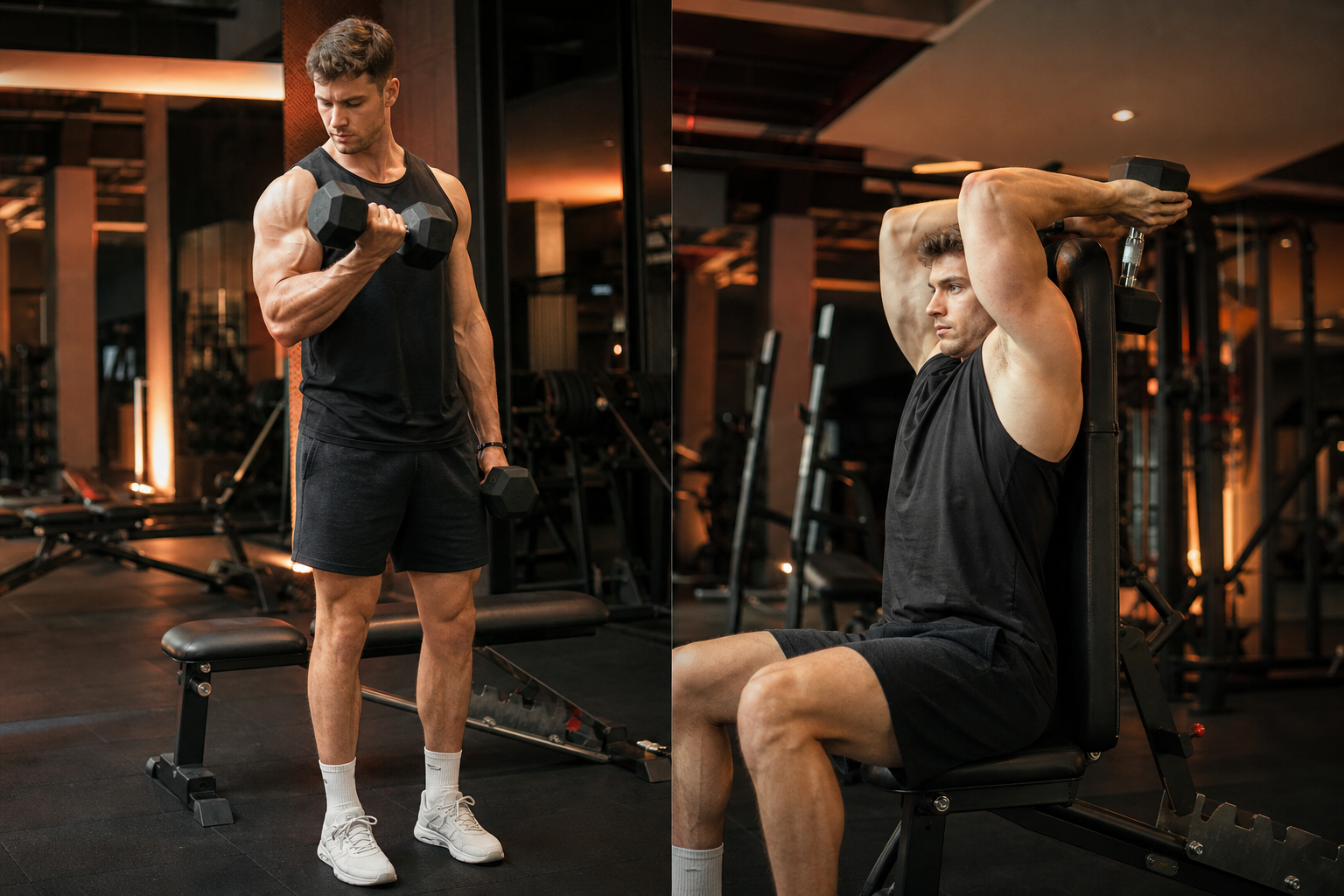
Dumbbells are the single most effective tool for arm training, and it comes down to one word: independence. Each arm must lift, stabilize, and control its own weight — there is no stronger side compensating for the weaker one. This forces balanced development and exposes strength imbalances that barbells and machines hide. A 2020 study in the Journal of Strength and Conditioning Research demonstrated that unilateral dumbbell training produced significantly greater muscle activation in the working limb compared to bilateral barbell exercises at the same relative intensity.
Dumbbells also offer unmatched grip variety. For biceps alone, you can use a supinated grip (palms up), neutral grip (palms facing each other, as in hammer curls), or even shift between grips mid-rep. This variety targets different elbow flexors — the biceps brachii, brachialis, and brachioradialis — for complete arm development. For triceps, dumbbells allow overhead positioning, which a barbell or cable cannot match comfortably, and this overhead stretch is critical for maximizing long-head activation.
This guide covers the two foundational dumbbell arm exercises: the dumbbell bicep curl and the dumbbell overhead tricep extension.
How to Do the Dumbbell Bicep Curl with Proper Form
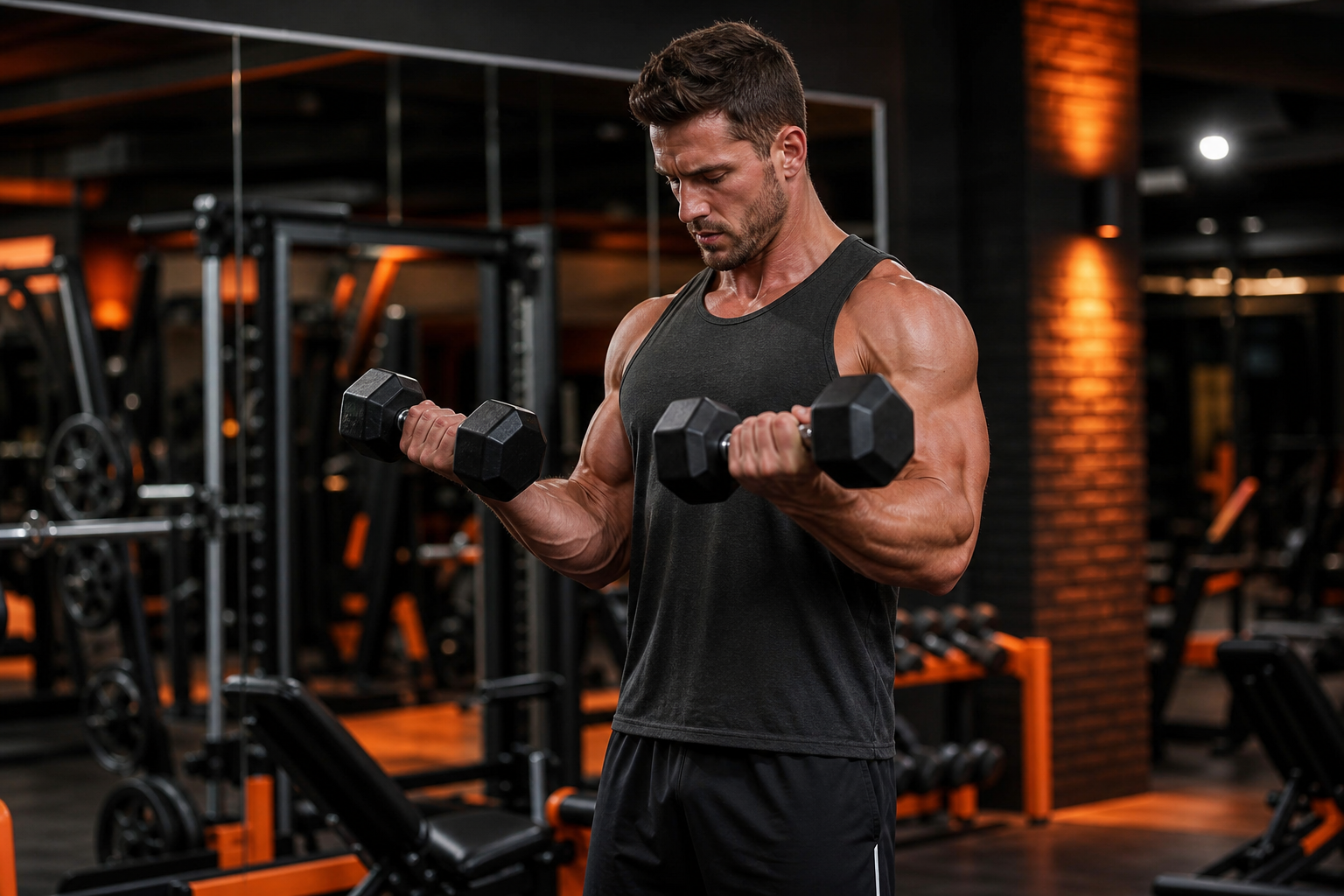
The dumbbell bicep curl is the most direct path to building bicep peak and thickness. It can be performed alternating (one arm at a time) or simultaneously (both arms together), standing or seated.
Step 1 — Grip and Standing Position
Stand with your feet shoulder-width apart, holding a dumbbell in each hand with arms hanging naturally at your sides. Use a supinated grip — palms facing forward. Your elbows should be locked against your ribs; they will act as the pivot point for the entire movement. Do not let them drift forward or backward. Engage your core slightly to prevent your torso from swaying. This is your start position for every single rep.
Step 2 — Lower (Eccentric)
From the top position, slowly lower the dumbbell back to the starting position. This is where most growth happens — the eccentric phase creates more micro-damage in the muscle fibers than the concentric. Control the descent for 2–3 seconds. Do not simply let the weight drop. As you lower, gradually rotate your wrist back to the fully supinated (palms forward) start position. Keep your elbow pinned to your side throughout.
Step 3 — Curl (Concentric)
Curl the dumbbell upward by flexing at the elbow. As the weight rises, gradually supinate your wrist — rotate your palm inward toward your shoulder. This supination at the top is what makes the dumbbell curl superior to the barbell curl: it fully engages the biceps brachii, which is a supinator as well as a flexor. Squeeze your bicep hard at the top for a beat. The dumbbell should end up near your front shoulder. Do not swing the weight up with your lower back or shrug your shoulder to gain height.
Step 4 — Breathing and Alternating
Exhale as you curl up, inhale as you lower down. If performing alternating curls, keep the non-working arm at your side — do not use it to generate momentum. The alternating style lets you focus 100% on one bicep at a time, which many lifters find produces a stronger mind-muscle connection. For simultaneous curls, both arms move together — this is slightly more time-efficient and creates a stronger overall fatigue response.
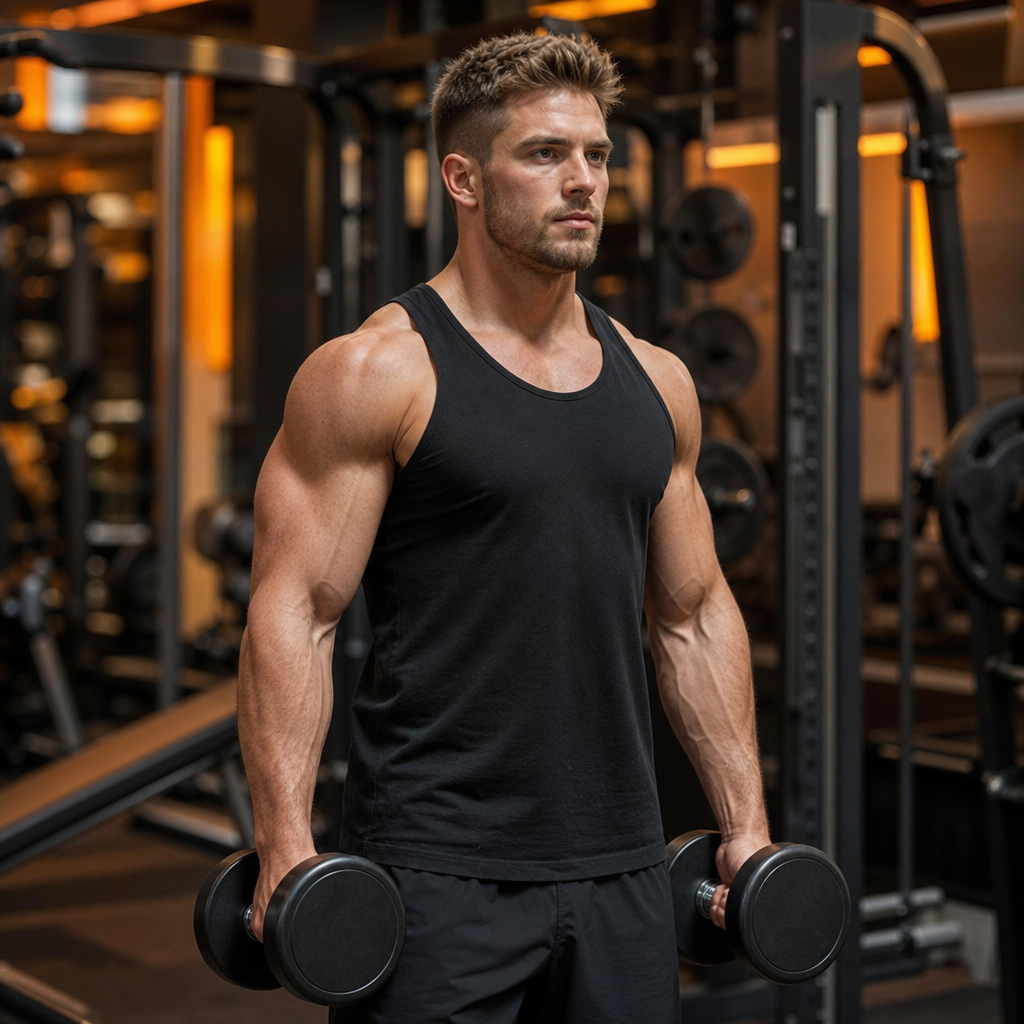
Dumbbell bicep curl at bottom position
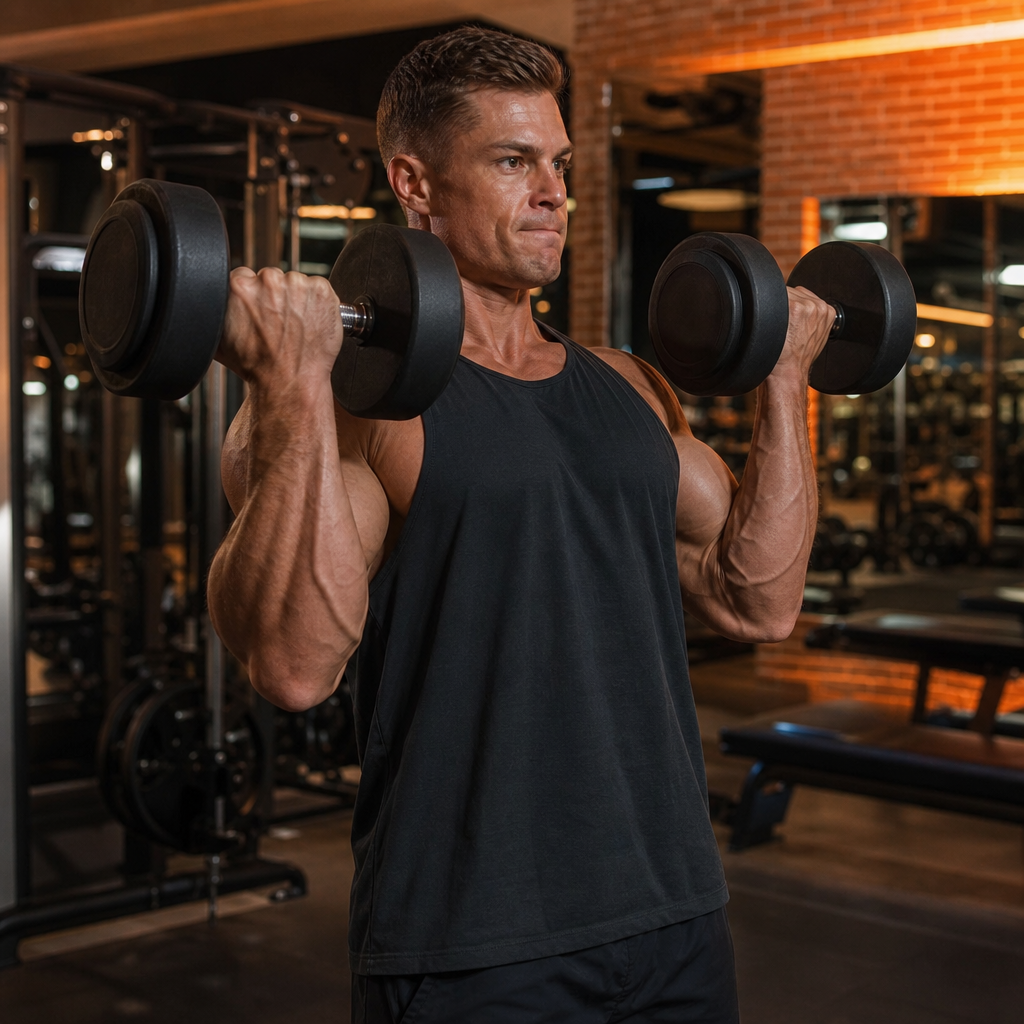
Dumbbell bicep curl at top contracted position
How to Do the Dumbbell Overhead Tricep Extension with Proper Form
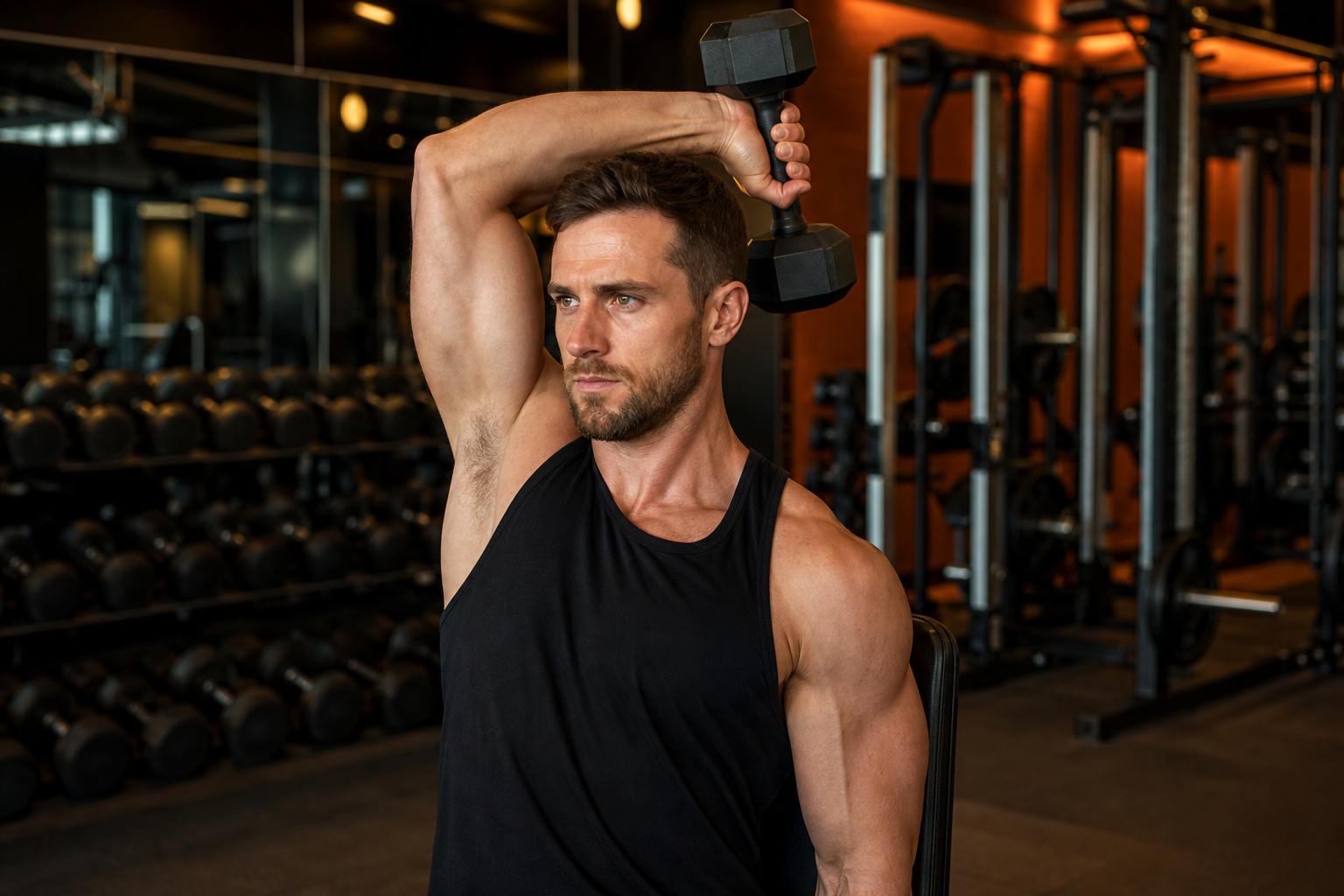
The dumbbell overhead tricep extension is the best exercise for targeting the long head of the triceps — the largest of the three heads, and the one responsible for the bulk of your upper arm mass. The overhead position stretches the long head to its fullest, which is essential because the long head crosses the shoulder joint and is only fully activated when the arm is raised overhead.
Step 1 — Grip and Starting Position
You can use one dumbbell with both hands or one dumbbell in each hand. For the single-dumbbell version: cup the inside of one dumbbell plate with both hands, palms facing upward, and lift it overhead. Your arms should be fully extended above your head with the dumbbell directly over your crown. Keep your elbows close to your head — they should point forward, not flare out to the sides. Plant your feet shoulder-width apart and brace your core. This elbow position is critical: it keeps the tension on the triceps and off the shoulder joints.
Step 2 — Lower Behind Head (Eccentric)
Bending only at the elbows, lower the dumbbell behind your head in a smooth arc. Your upper arms should stay vertical and motionless — only your forearms move. Lower until you feel a deep stretch in your triceps, typically when your forearms are near parallel to the floor or slightly below. This stretch is the whole point of the overhead position. Control the descent for 2–3 seconds. Do not let your elbows drift backward or your upper arms drop — this turns the exercise into a pressing movement and removes tension from the triceps.
Step 3 — Extend (Concentric)
From the stretched position, extend your elbows to press the dumbbell back to the starting position overhead. Squeeze your triceps hard at full lockout for a beat. The motion should feel like you are pushing the weight through the ceiling. Do not use your shoulders or back to assist — if you find yourself leaning back or pushing with your legs, the weight is too heavy.
Step 4 — Breathing
Inhale as you lower the weight behind your head, exhale as you extend it back to lockout. This breathing pattern supports the harder concentric phase when your muscles need oxygen most. If performing single-arm variations, complete all reps on one side before switching — this keeps the triceps under continuous tension without rest.
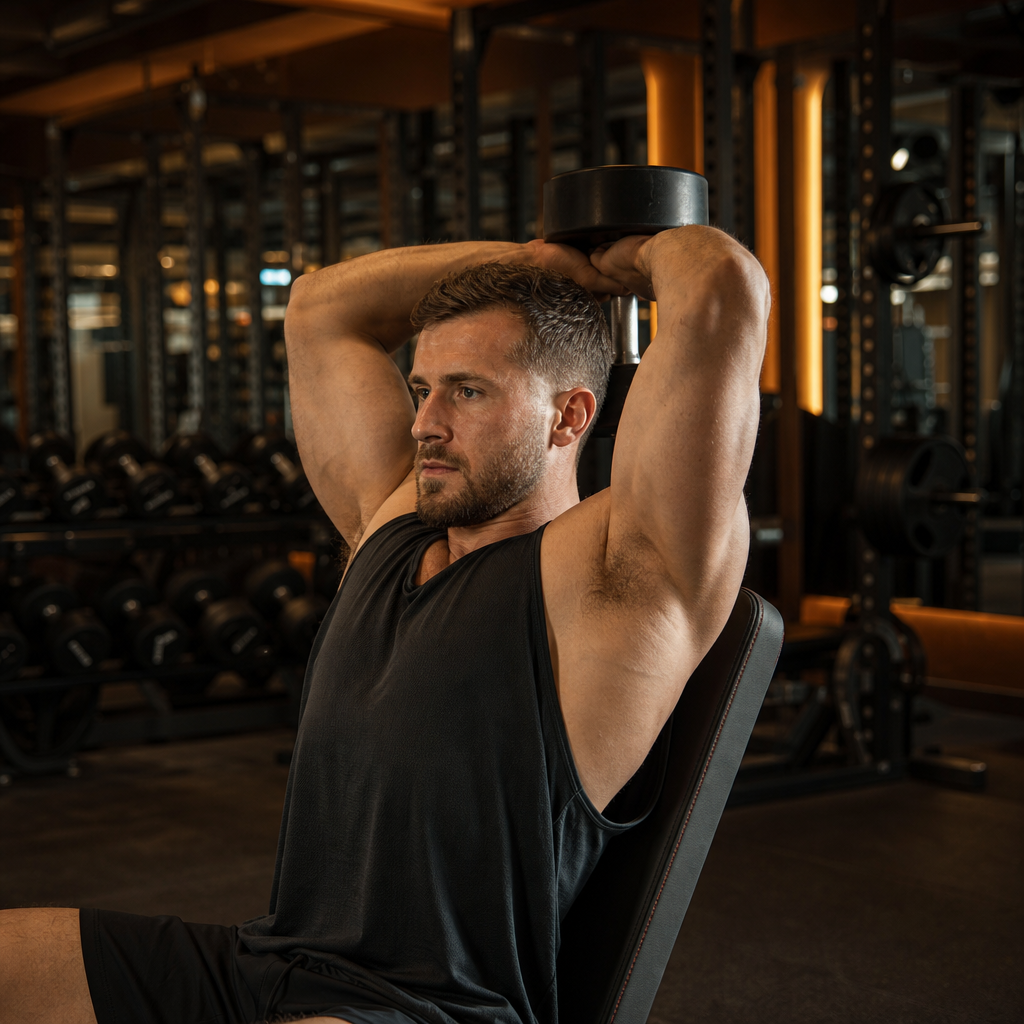
Dumbbell overhead tricep extension at bottom stretched position
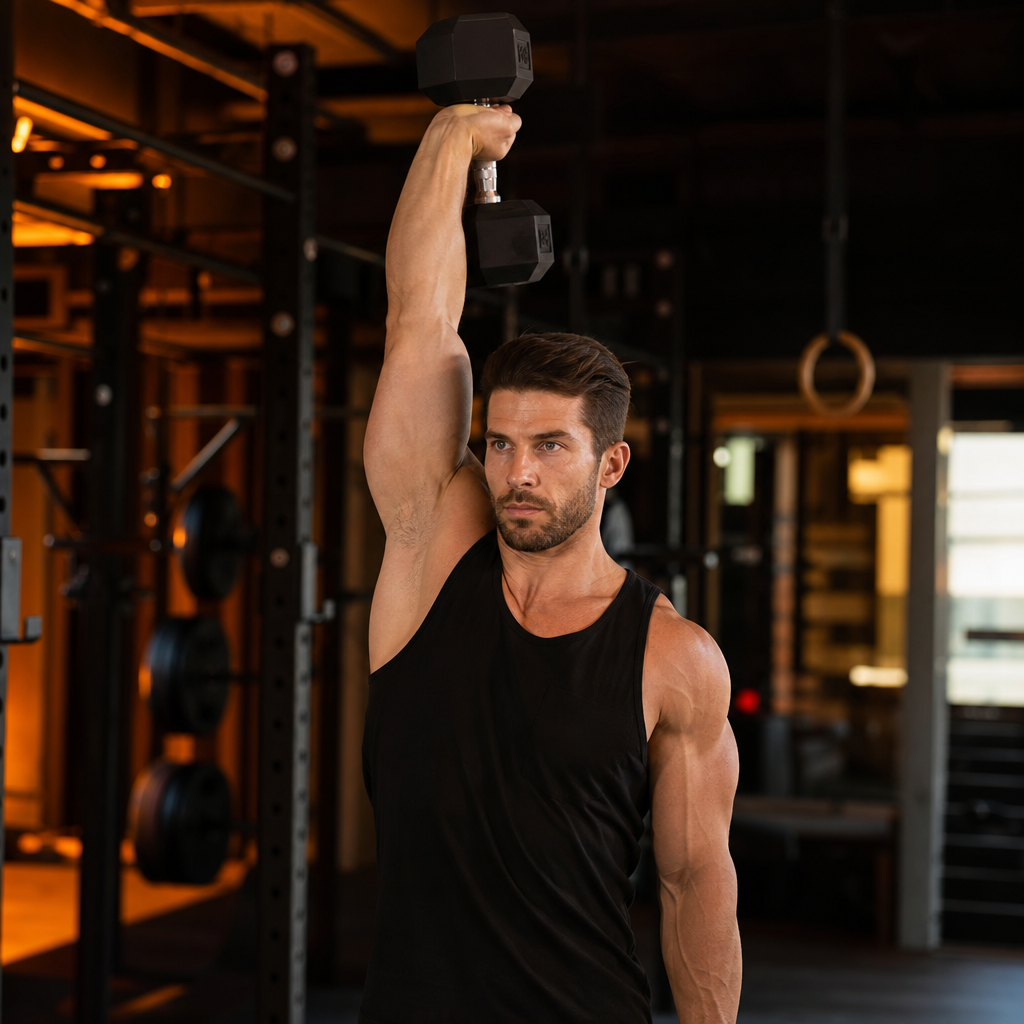
Dumbbell overhead tricep extension at top lockout position
What Are the Most Common Dumbbell Arm Mistakes
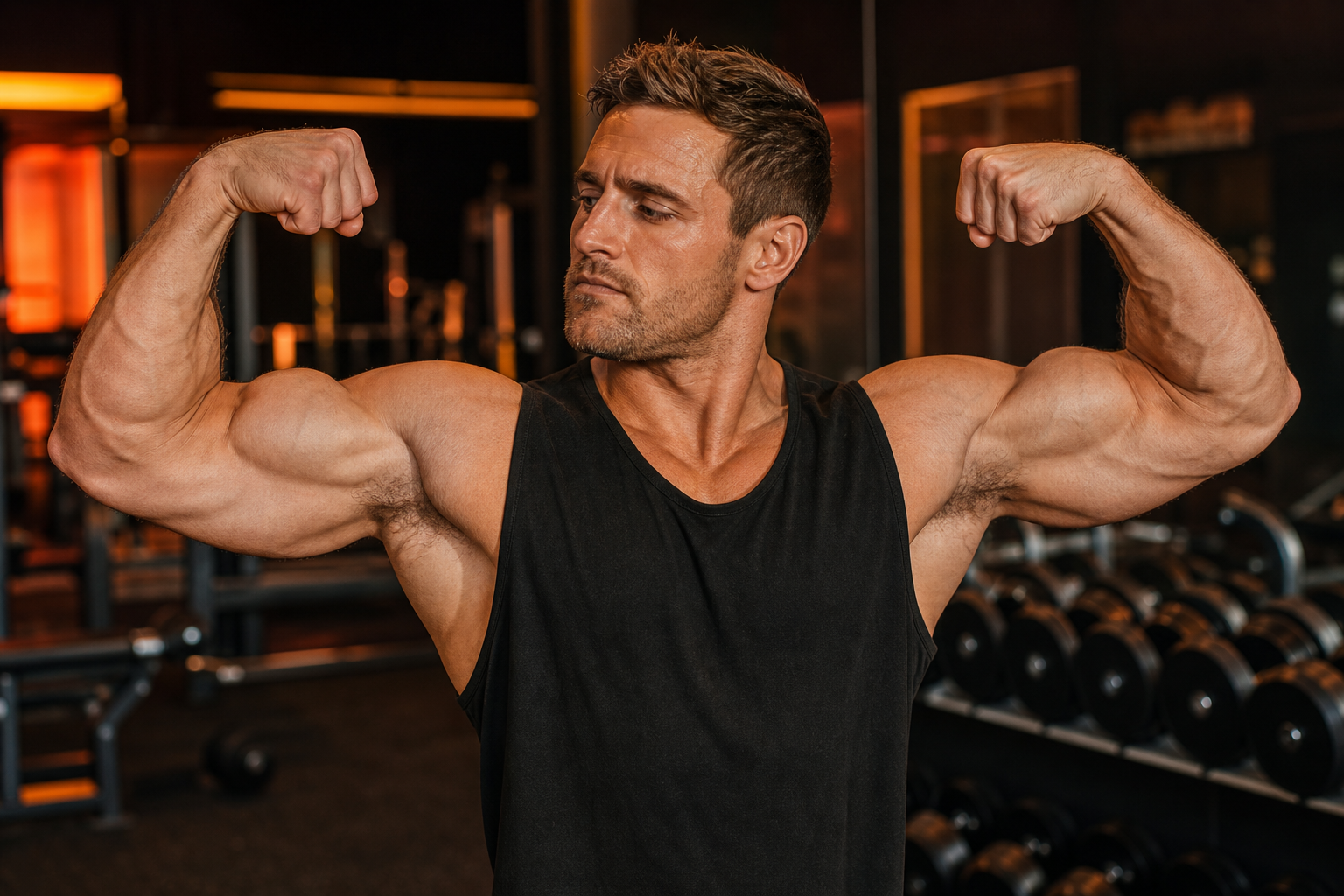
These errors sabotage your arm gains and increase injury risk. Fix them to get the most out of every rep.
Swinging and using momentum: The most common curl mistake. If your torso rocks back and forth, your lower back and delts are doing the work, not your biceps. Stand against a wall or use a preacher bench to eliminate cheating. Light weight with strict form beats heavy weight with momentum every time.
Not using full range of motion on curls: Stopping the curl halfway down or halfway up means you are missing the stretch and the peak contraction. Let the arm fully extend at the bottom (without hyperextending the elbow) and curl all the way to the shoulder. Full ROM = full growth.
Flaring elbows on tricep extension: If your elbows drift out to the sides during the overhead extension, you shift the load from the triceps to the shoulders and chest. Keep your elbows pointing forward, close to your head, throughout the entire movement. Think of your upper arms as fixed pillars.
Going too heavy: Arms respond best to controlled tension, not ego lifting. If you cannot hold the top contraction for a beat on curls or lock out fully on extensions, the weight is too heavy. Drop the weight and own every inch of the range of motion.
Neglecting the eccentric: The lowering phase is where the real muscle damage — and growth stimulus — happens. Rushing the eccentric on curls or extensions is leaving gains on the table. Control every rep for at least 2–3 seconds on the way down.
What Are the Key Takeaways
| Point | Recommendation |
|---|---|
| Why dumbbells for arms | Independent arm work + fixes imbalances + grip variety + overhead stretch |
| Dumbbell curl form | Palms forward, supinate at top, elbow pinned to ribs, 2–3 sec eccentric |
| Overhead extension form | Elbows close to head, upper arms vertical, deep stretch behind head, lockout at top |
| Curl peak contraction | Squeeze at top with full supination for maximum bicep activation |
| Extension stretch | Overhead position stretches long head — the key to tricep mass |
Quick mistake checklist:
- Swinging on curls — stand against a wall or reduce weight
- Half reps on curls — full ROM from full extension to shoulder
- Flaring elbows on extension — keep elbows forward, close to head
- Going too heavy — if you cannot hold the contraction or lock out, drop the weight
- Rushing the eccentric — control 2–3 seconds on every lowering phase
Recommended arm day combination: Dumbbell bicep curl 4×10 + Dumbbell hammer curl 3×12 + Dumbbell overhead tricep extension 4×10 + Dumbbell kickback 3×12. Biceps + triceps = complete arm development.
Frequently Asked Questions
Should I lift heavy or light for arm growth?
Both. Heavy compound pulls (rows, chin-ups) build the foundation, while moderate-weight isolation (curls, extensions) adds detail. For pure arm size, 8-12 reps on curls and 10-15 on extensions hits the sweet spot between mechanical tension and metabolic stress.
How many times a week should I train arms?
2-3 times per week works for most people. Arms recover faster than large muscle groups, so you can hit them more frequently — just avoid training them to failure every session. One heavy day and one pump day is a solid split.
Why do my biceps hurt during curls but my forearms give out first?
Your grip is the weak link. Use a thumbless (suicide) grip to take the forearms out of the movement, or try lifting straps on heavier sets. Also check that your wrists are straight, not extended — flexed wrists fatigue the forearms faster.
References & Sources
1RM Calculator (One-Rep Max)
Estimate your one-rep max (1RM) - the maximum weight you can lift for a single repetition - from a weight you can lift for multiple reps. The calculator uses the Epley and Brzycki equations and averages them.
Strength Standards Calculator
How strong are you compared to other lifters? Enter your bodyweight and best lift to see where you rank - from Beginner to Elite - on the bench press, squat, deadlift, and overhead press. Standards are scaled to your bodyweight, so a 60 kg lifter and a 100 kg lifter are judged fairly.
Protein Intake Calculator
Calculate how much protein you need each day based on your body weight and training goal. This calculator uses the research-backed range of 1.6 to 2.2 grams of protein per kilogram of body weight for building muscle.