
Cable Arm Workout: Cable Bicep Curl and Tricep Pushdown
Cable arm training builds the biceps and triceps with constant tension. For cable curls, curl the low-pulley handle toward your shoulders with elbows fixed. For triceps pushdowns, push the high-pulley bar down until your arms are straight, keeping your elbows tucked. Cables keep tension through the full range, making them effective for arm hypertrophy.
Why Cables Are Perfect for Arm Training
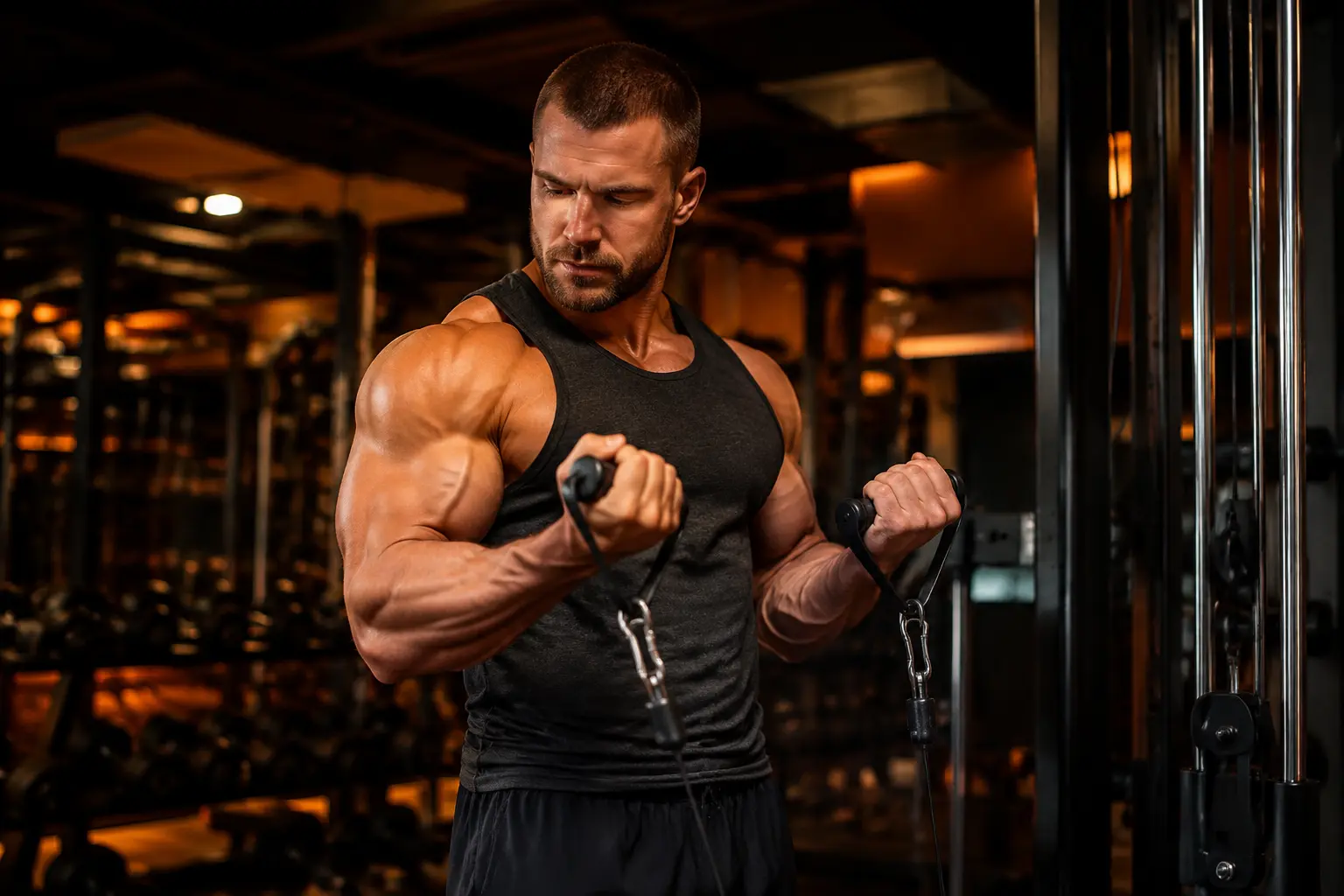
Cable machines deliver something free weights struggle to provide for arm training: constant, consistent tension across the entire range of motion. When you do a dumbbell curl, resistance peaks at roughly 90° of elbow flexion and drops to nearly zero at the bottom — gravity only pulls straight down, so the lever arm vanishes when your arm hangs. A cable, by contrast, pulls horizontally from the pulley, keeping your biceps and triceps under load from the first inch to the last.
This constant tension is a major advantage for arm hypertrophy. A 2023 systematic review in the European Journal of Sport Science found that exercises with more uniform resistance profiles — like cable-based movements — produced comparable or slightly greater muscle activation in isolated muscle groups compared to free-weight equivalents, particularly at the endpoints of the range of motion where free weights offer the least stimulus. For arms specifically, this means your biceps get tension at the fully stretched position and your triceps stay loaded at full extension — exactly where dumbbells and barbells offer the least resistance.
This guide covers the two most effective cable arm exercises: the cable bicep curl for building sleeve-busting biceps and the cable tricep pushdown for horseshoe triceps.
How to Do the Cable Bicep Curl with Proper Form
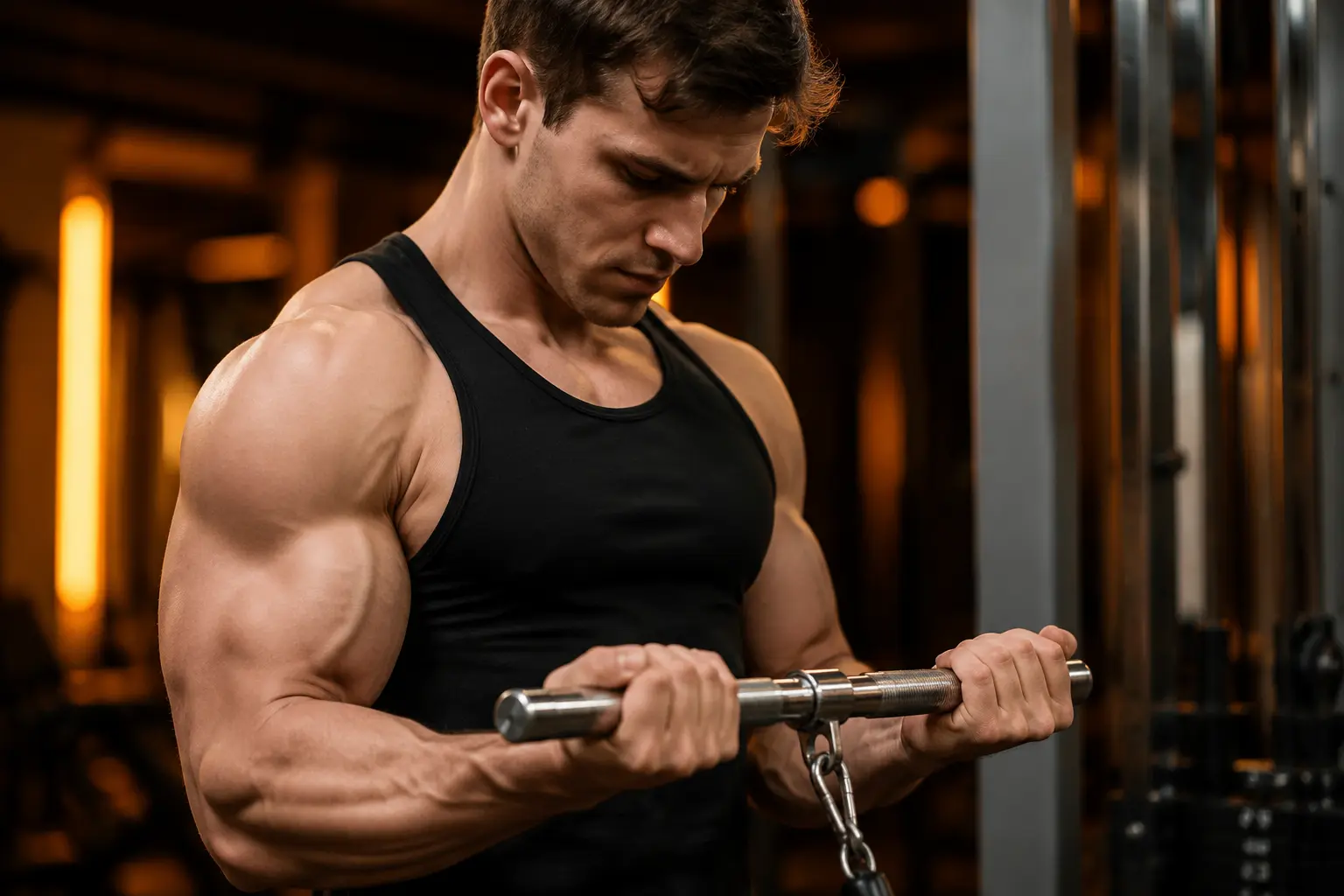
The cable bicep curl provides constant tension that dumbbells simply cannot match. This makes it one of the most effective exercises for building bicep size and definition.
Step 1 — Setup and Pulley Position
Set the cable pulley to the lowest position. Stand facing the machine about 2 feet back, feet shoulder-width apart, knees slightly bent. Grab the straight bar or rope attachment with an underhand (supinated) grip. Your arms should hang naturally at your sides with elbows pinned to your ribs. Stand tall with your chest up and shoulders pulled back slightly — no hunching forward.
Step 2 — Starting Position
With arms fully extended downward, the cable already provides tension — this is the advantage over dumbbells. Keep your wrists straight and neutral, not flexed or extended. Your upper arms must stay glued to your sides from start to finish. Engage your core and maintain a slight backward lean (5°) to prevent your torso from swinging. This is your start position, and the biceps are already under load.
Step 3 — Curl to Shoulder Height
In a controlled motion, curl the handle upward by flexing your elbows. Squeeze your biceps hard at the top — the cable keeps tension here, unlike a dumbbell where resistance drops off above 90°. Only your forearms move; your upper arms stay pinned to your sides. Do not let your elbows drift forward — if they do, your front delts take over. At the top, your hands should be at approximately chest to chin height, depending on the attachment length.
Step 4 — Breathing and Eccentric Control
Exhale as you curl the weight up, inhale as you lower it back down. The eccentric (lowering) phase is where cables truly shine — the constant tension means your biceps work hard all the way down. Lower slowly over 2-3 seconds. Do not let the weight stack crash. Aim for 10-15 reps per set. The constant tension makes lighter weights feel heavier, so you do not need to go as heavy as with dumbbells to get the same stimulus.
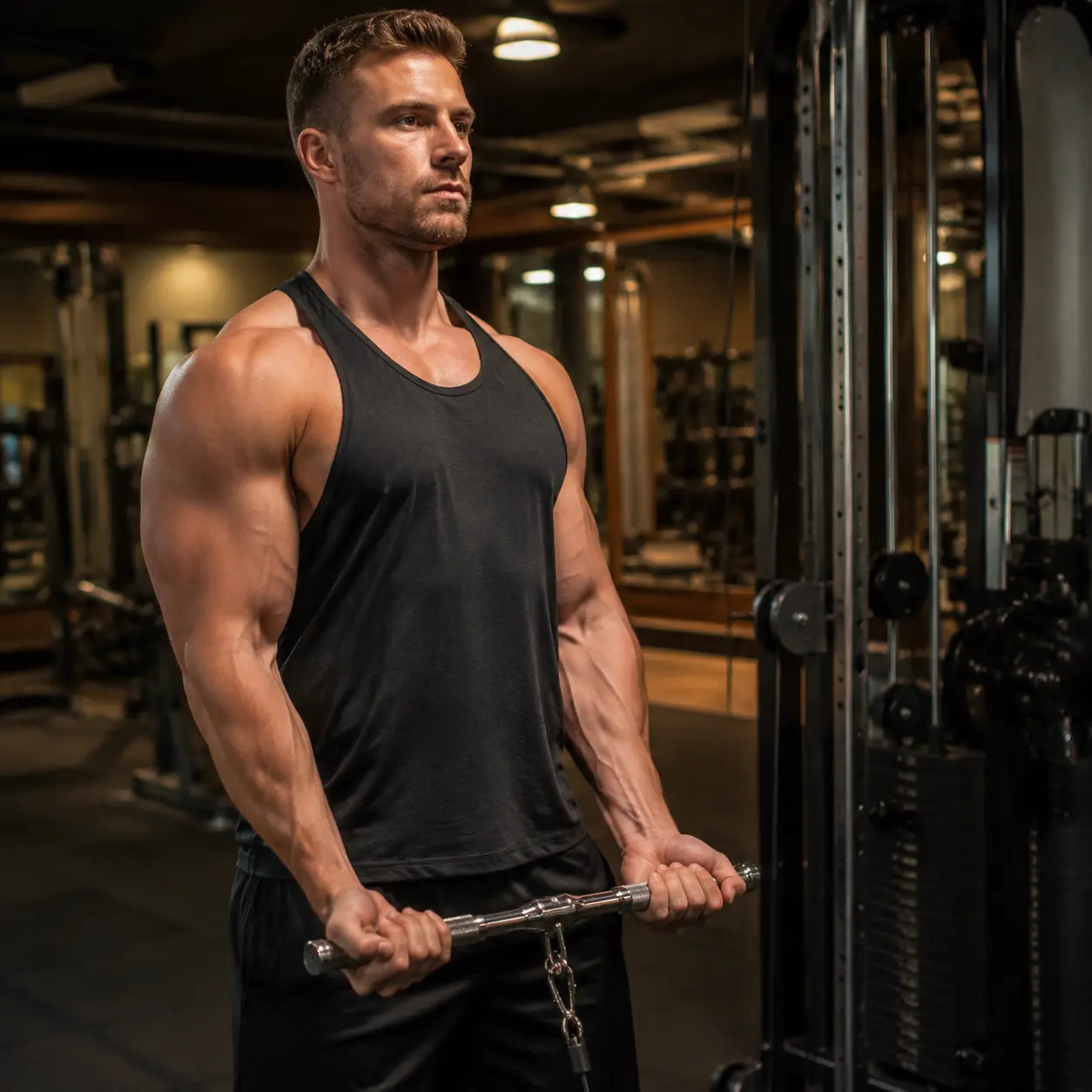
Cable bicep curl bottom starting position with arms extended
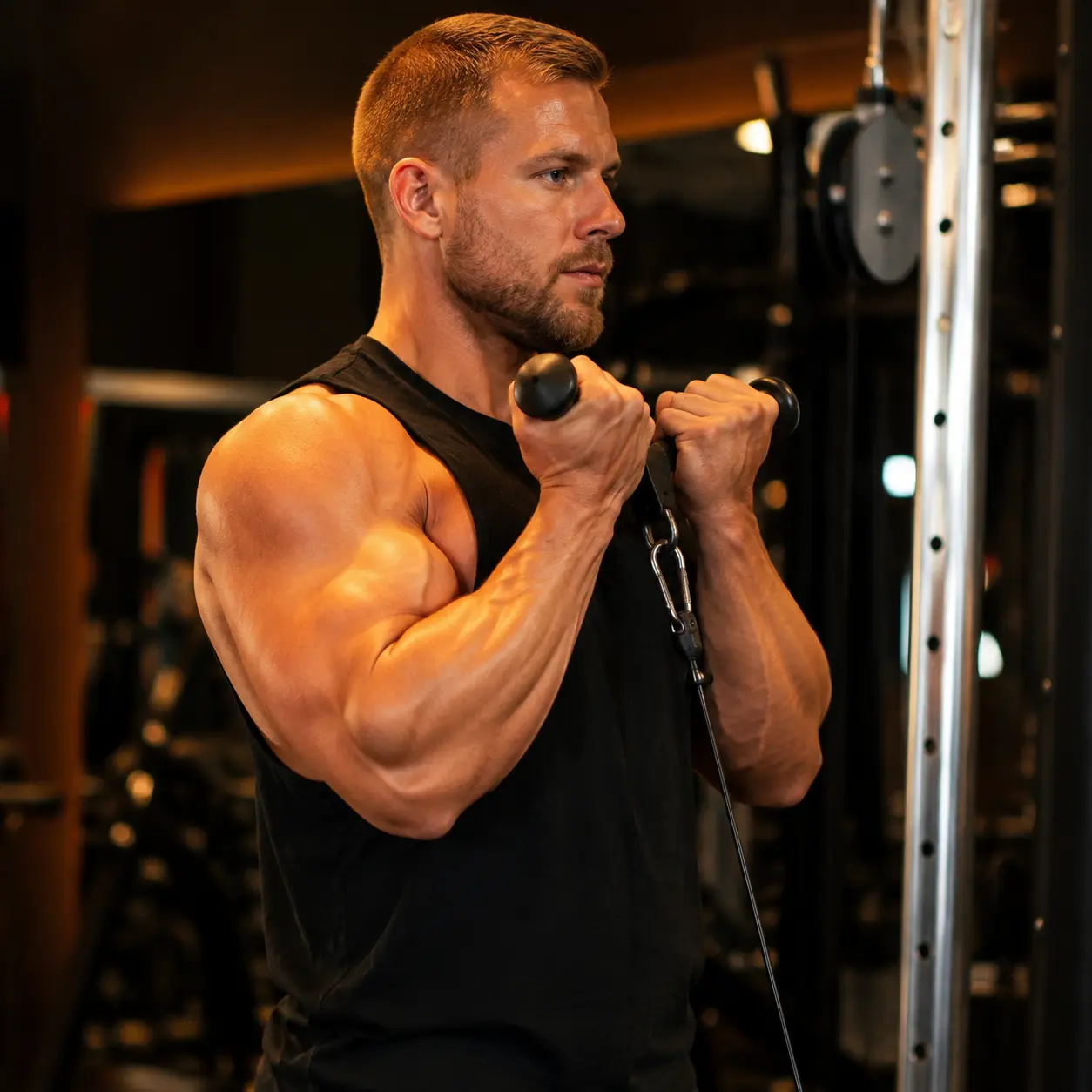
Cable bicep curl top position with full contraction
How to Do the Cable Tricep Pushdown with Proper Form
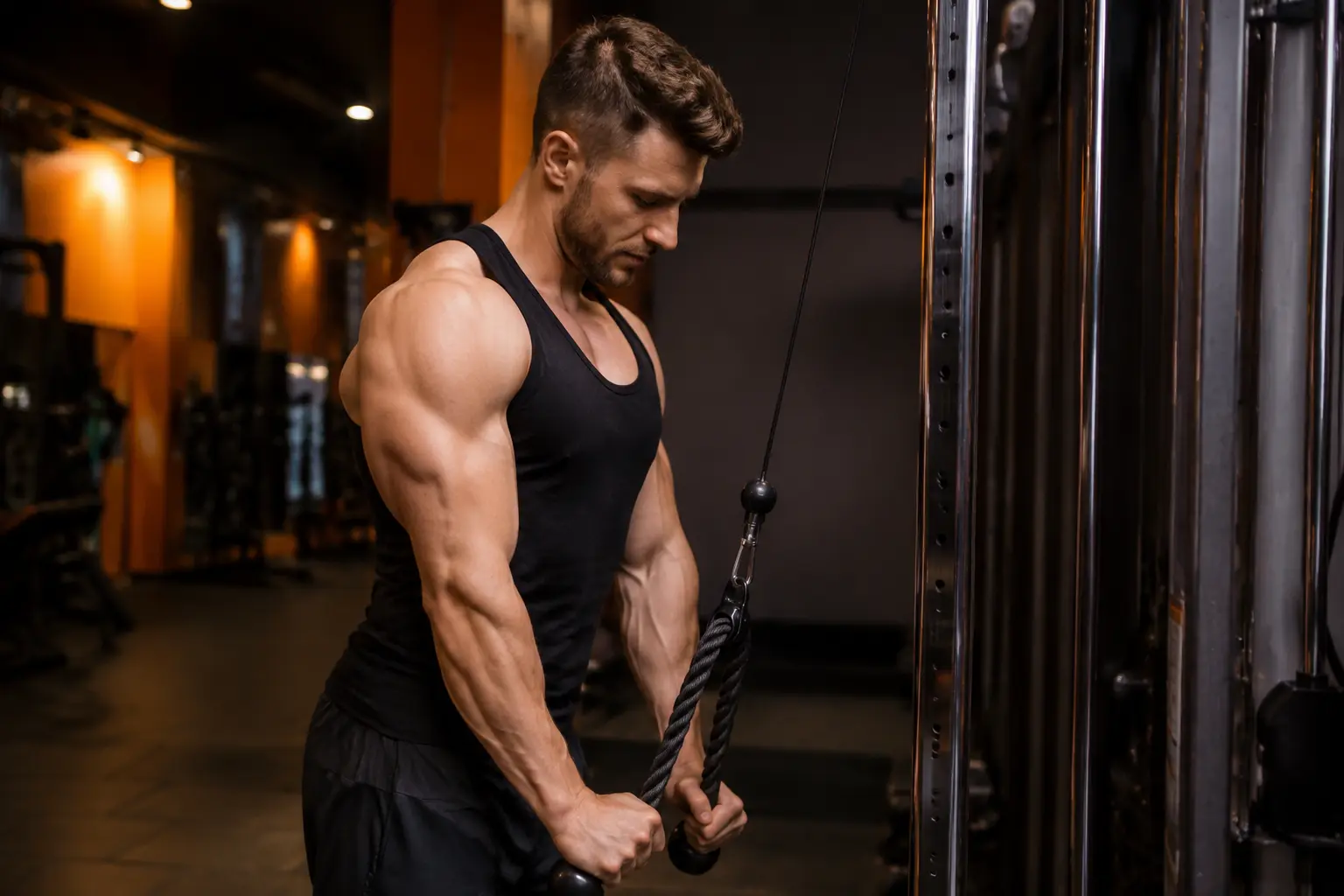
The cable tricep pushdown is the most popular tricep exercise for good reason — it isolates the triceps with constant tension and allows you to use various attachments to target different heads. The rope attachment is recommended for most lifters because it permits external rotation at the bottom, activating all three tricep heads through a fuller range.
Step 1 — Setup and Rope Attachment
Set the cable pulley to the highest position. Attach a rope handle. Stand facing the machine about 1-2 feet back with feet shoulder-width apart. Grab the rope ends with a neutral grip (palms facing each other). Pull the rope down until your elbows are at roughly 90° and tucked tight against your ribs. Lean slightly forward (about 10°) from the hips with your core braced — this prevents your body from swinging and keeps the focus on your triceps.
Step 2 — Starting Position (90° Elbow Bend)
Your elbows are bent at approximately 90°, pinned to your sides, and the rope is at chest height. Your upper arms stay fixed from this point onward — they do not move during the exercise. Your forearms are the only moving part. This is the start of every rep. The cable provides tension even in this resting position, which is the key advantage over skull crushers or dips where the bottom has minimal load.
Step 3 — Push Down to Full Extension
Press the rope downward by extending your elbows fully. At the bottom, actively spread the rope ends apart (external rotation) — this engages the medial head and gives a harder squeeze to the lateral head. Your arms should be completely straight with the rope ends separated at roughly hip width. Squeeze your triceps hard for a full second at full lockout. The external rotation at the bottom is what distinguishes an effective pushdown from a mediocre one — it adds range and muscle activation that a straight bar cannot provide.
Step 4 — Breathing and Return
Exhale as you push down, inhale as you let the rope rise back to the 90° starting position. Control the return — do not let the weight snap back up. The eccentric should take 2-3 seconds. Letting the rope fly back takes all tension off the triceps at exactly the point where cables offer their biggest advantage. Use a moderate weight and focus on the squeeze. Aim for 12-15 reps. Pushdowns reward control, not brute force.
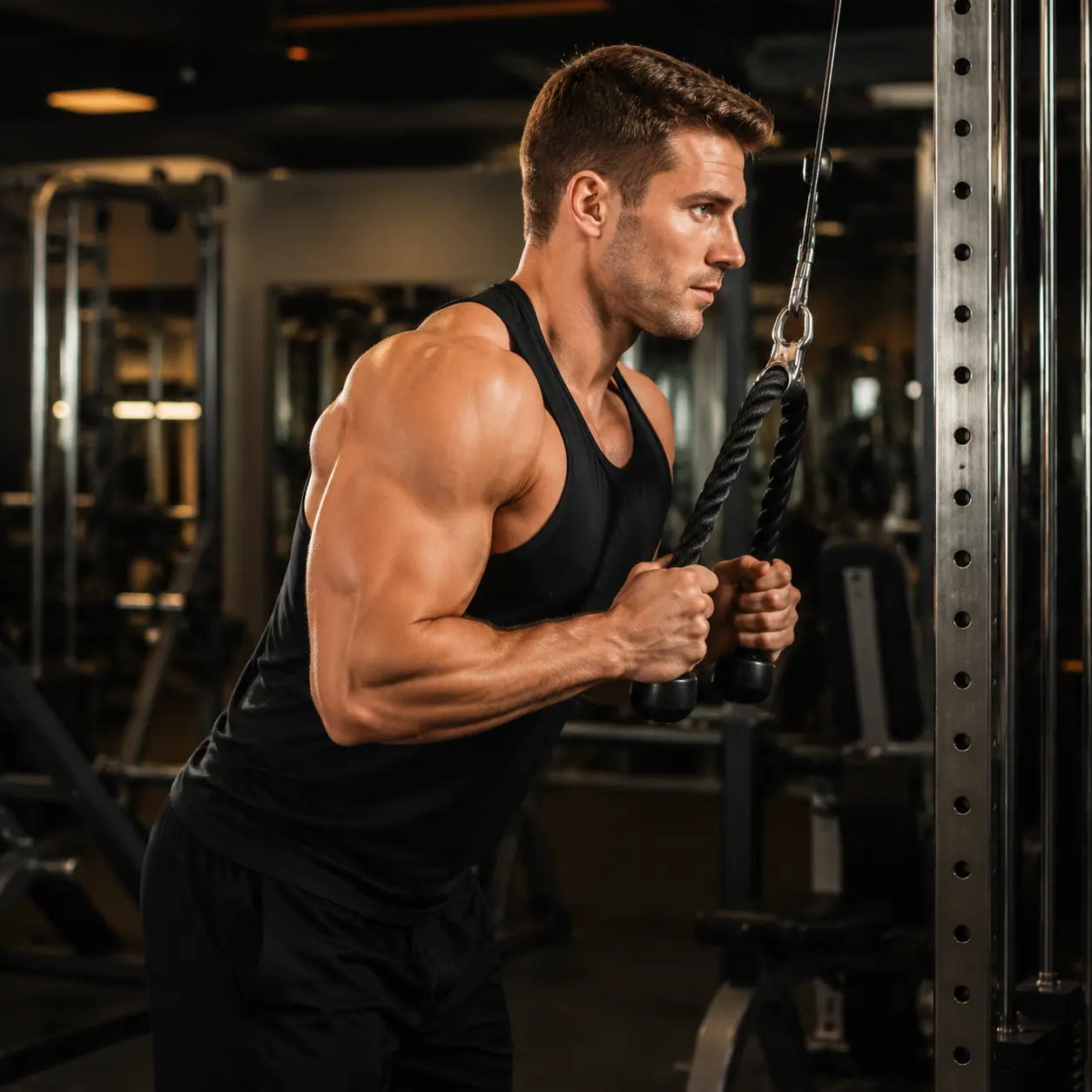
Cable tricep pushdown starting position with elbows at 90 degrees
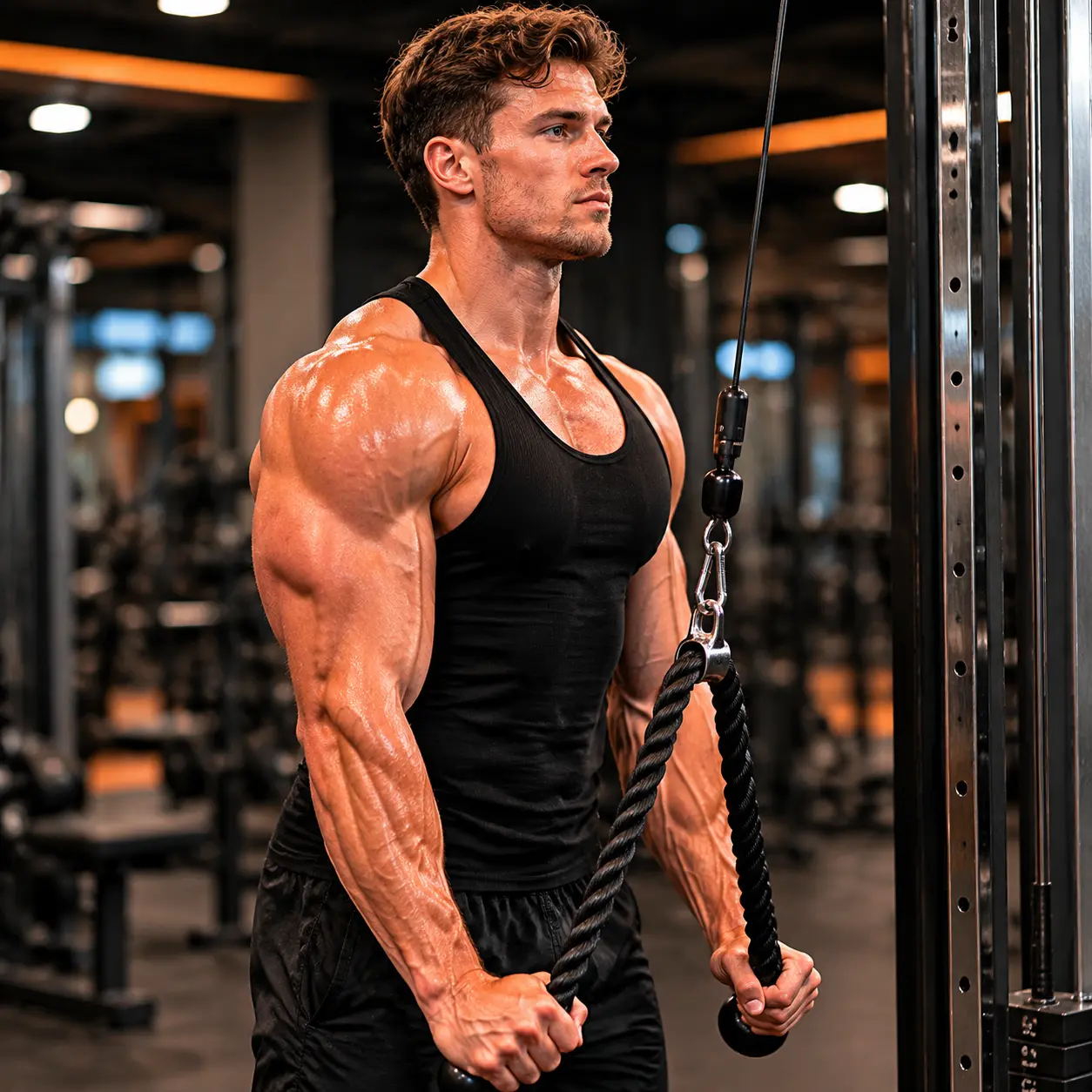
Cable tricep pushdown bottom position with full extension and rope spread
What Are the Most Common Cable Arm Training Mistakes
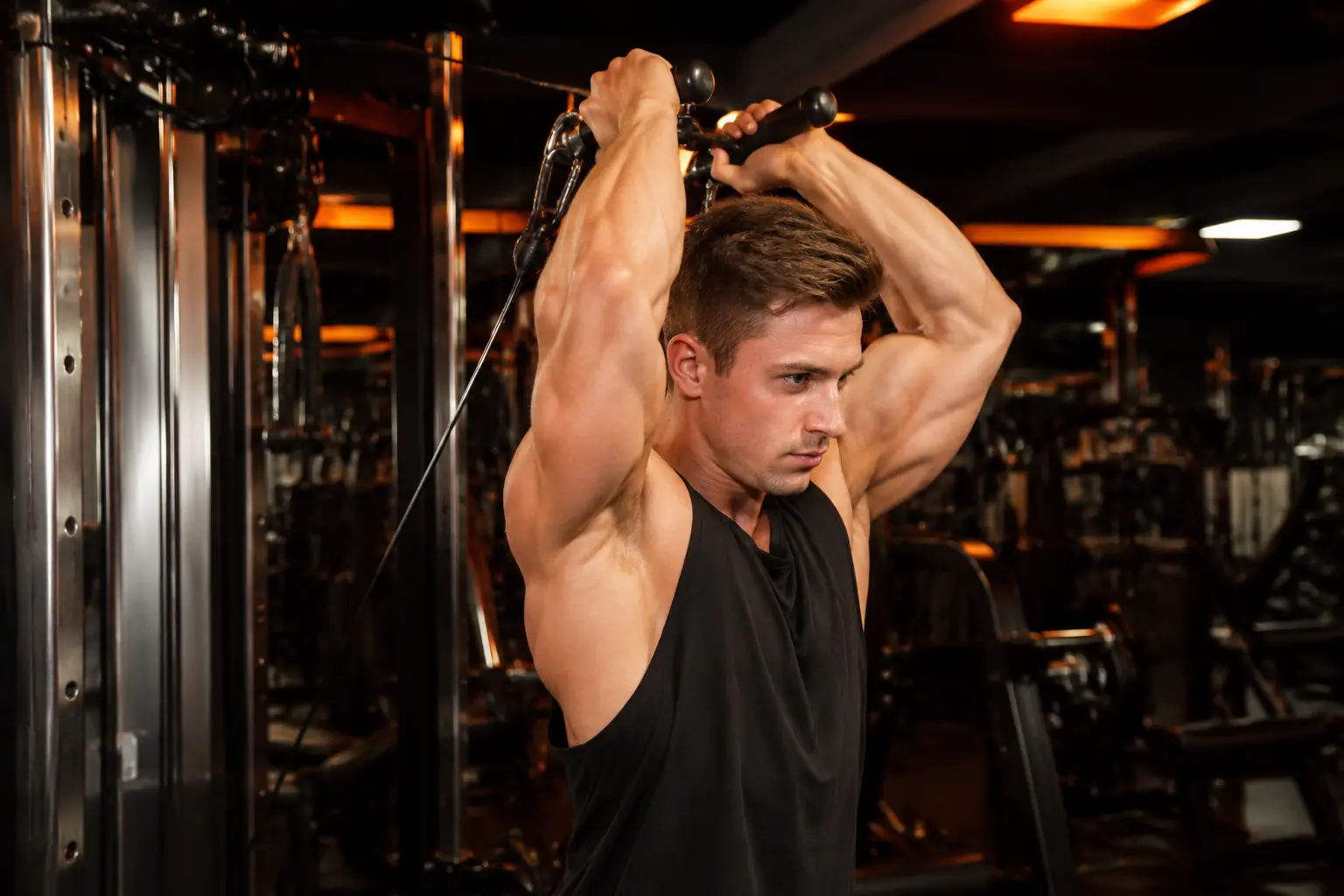
These errors reduce effectiveness and increase injury risk. Fix them to get the most from your cable arm training.
Elbows drifting forward on curls: This is the most common curl mistake. When your elbows move forward, your front delts take over and bicep tension drops sharply. Pin your elbows to your ribs — imagine there is a wall behind them. If you cannot keep them still, the weight is too heavy.
Using momentum on pushdowns: Leaning your body weight into the pushdown turns an isolation exercise into a bodyweight press. The triceps are small muscles that respond best to controlled isolation. Stand upright, brace your core, and only move your forearms. If you need to lean in, lighten the load.
Not using the rope spread at the bottom of pushdowns: Failing to separate the rope ends at full extension skips the external rotation component — the part that activates the medial head and deepens the lateral head squeeze. A straight bar pushdown is fine for heavy loading, but the rope with spread is superior for complete tricep development.
Cutting the range of motion short: On curls, not fully extending at the bottom wastes the constant-tension advantage where cables outperform dumbbells. On pushdowns, not reaching full lockout misses the hardest contraction point. Use a full range — the cable's tension profile is designed for it.
Flexed wrists on curls: Bending your wrists back during curls shifts stress to the forearm flexors and away from the biceps. Keep your wrists straight and neutral — think of your hands as hooks, not grippers. The bicep does the curling, not the grip.
What Are the Key Takeaways
| Point | Recommendation |
|---|---|
| Why cables for arms | Constant tension at endpoints where free weights offer least stimulus |
| Cable bicep curl setup | Low pulley, underhand grip, elbows pinned to sides |
| Cable bicep curl range | Full extension to chest height — use the entire range |
| Tricep pushdown setup | High pulley, rope attachment, slight forward lean |
| Pushdown rope spread | Separate rope ends at bottom — external rotation for medial head |
| Both exercises | Control eccentric 2-3s, keep elbows fixed, straight wrists |
Quick mistake checklist:
- Elbows drifting forward on curls — pin them to your ribs or reduce the weight
- Leaning into pushdowns — stand upright, only forearms move
- Not spreading the rope at bottom — this is the whole point of the rope attachment
- Cutting range short — full extension on curls, full lockout on pushdowns
- Flexed wrists on curls — keep wrists straight, hands are hooks not grippers
Recommended arm day combination: Barbell curl 4×8 + Cable bicep curl 3×12 + Close-grip bench 4×10 + Cable pushdown 3×15 + Overhead cable extension 3×12. Heavy compound loading + constant-tension isolation + long head stretch = complete arm development.
Frequently Asked Questions
Are cable curls better than dumbbell curls for biceps?
Cable curls provide constant tension throughout the entire range of motion, unlike dumbbells where resistance drops to near zero at the bottom. This makes cables superior for time under tension and high-rep hypertrophy work. However, dumbbells allow greater overload at the peak contraction. Both have value — cables for pump and tension, dumbbells for heavy loading.
What attachment should I use for tricep pushdowns?
A straight bar targets the long head more directly with a pronated grip. A rope attachment allows external rotation at the bottom, engaging all three tricep heads through a fuller range. A V-bar is a middle ground. For complete tricep development, rotate between rope and straight bar — rope for range, bar for load.
Should my elbows move during cable curls?
No. Your upper arms should stay pinned to your sides throughout the entire set. If your elbows drift forward, your front delts take over and the bicep tension drops. Think about keeping your elbows in one spot — only your forearms move. If you cannot maintain this, the weight is too heavy.
How do I target the long head of the triceps with cables?
Overhead cable tricep extensions place the long head in a stretched position under load, which is the most effective way to target it. The pushdown hits the lateral head more. For balanced tricep development, include both: pushdowns for the lateral head and overhead extensions for the long head.
References & Sources
1RM Calculator (One-Rep Max)
Estimate your one-rep max (1RM) - the maximum weight you can lift for a single repetition - from a weight you can lift for multiple reps. The calculator uses the Epley and Brzycki equations and averages them.
Strength Standards Calculator
How strong are you compared to other lifters? Enter your bodyweight and best lift to see where you rank - from Beginner to Elite - on the bench press, squat, deadlift, and overhead press. Standards are scaled to your bodyweight, so a 60 kg lifter and a 100 kg lifter are judged fairly.
Protein Intake Calculator
Calculate how much protein you need each day based on your body weight and training goal. This calculator uses the research-backed range of 1.6 to 2.2 grams of protein per kilogram of body weight for building muscle.