
How to Do Dips: Bench & Parallel Bar Form Guide
The dip is a pushing exercise that targets the triceps, chest, and shoulders. Support yourself on parallel bars with arms straight and shoulders down, lean slightly forward to bias the chest, lower your body by bending your elbows to 90 degrees, then press back up to the start without shrugging.
What Muscles Do Dips Actually Work?
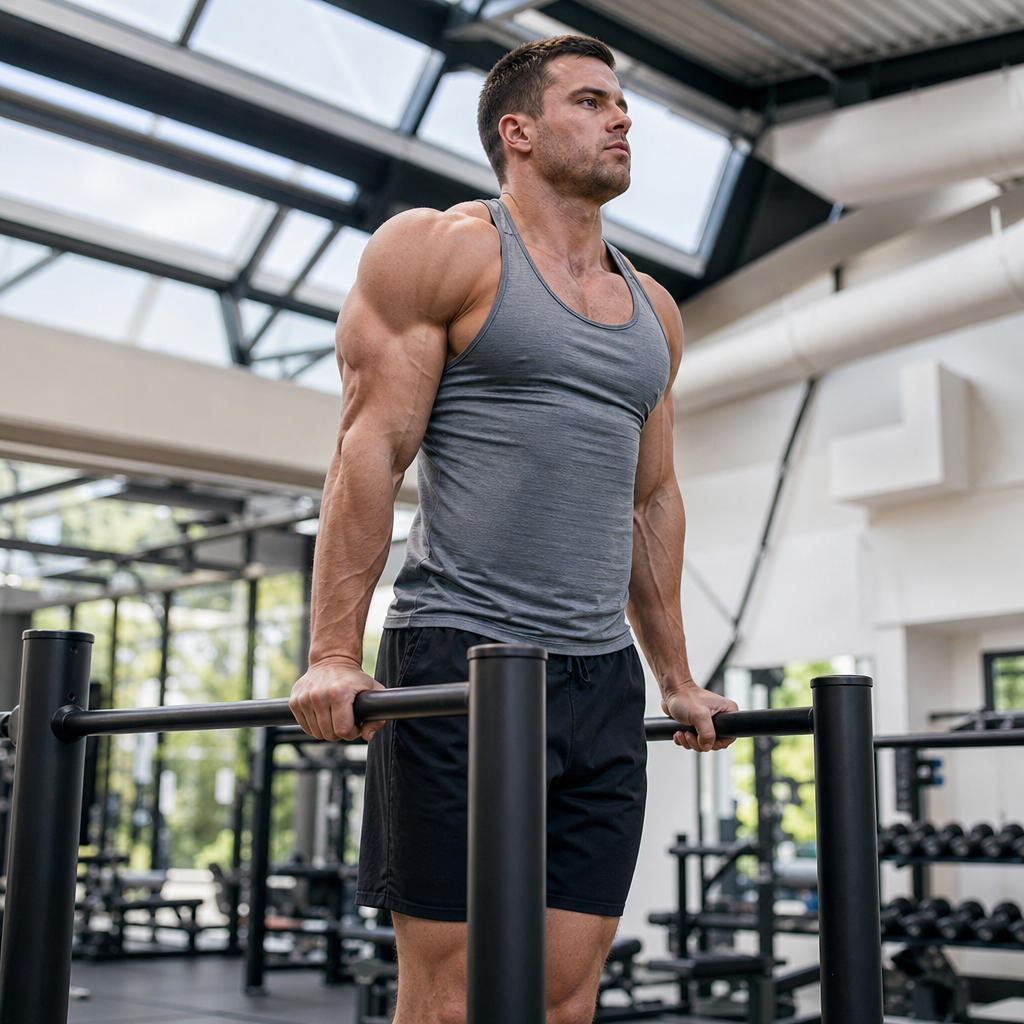
The dip is one of the most underrated upper-body exercises in any training program. Unlike the horizontal pushing pattern of a push-up, a dip is a vertical push — your body is suspended in space and your arms work to lock the elbows out against gravity. This shifts the loading dramatically toward the triceps and the lower fibers of the pectoralis major.
A 2014 EMG study published in the Journal of Strength and Conditioning Research measured muscle activation across several upper-body pressing exercises and found that parallel bar dips activate the triceps brachii at over 87% of maximum voluntary contraction (MVC) — making them one of the most effective bodyweight movements for arm development. By comparison, lying triceps extensions and standard push-ups produced significantly lower triceps activation in the same study.
Muscles Worked
- Primary mover: Triceps brachii (all three heads — long, lateral, and medial — driving elbow extension)
- Heavy assistance: Lower pectoralis major (sternal fibers, especially during the forward-lean variation), anterior deltoid (front of shoulder, controls shoulder flexion at the bottom)
- Stabilizers: Rhomboids and lower trapezius (hold the scapulae down and back), serratus anterior (prevents shoulder shrug), core musculature (keeps the legs from swinging)
Chest vs Triceps — How Torso Angle Shifts Emphasis
| Torso Lean | Primary Target | Best For |
|---|---|---|
| Vertical (chest up) | Triceps (long head emphasized) | Arm size, lockout strength |
| 15-30° forward lean | Mixed triceps + lower chest | Balanced upper-body development |
| 45°+ forward lean (hips back) | Lower chest (sternal pec) | Lower-chest hypertrophy, fuller pec shape |
This single lever — torso lean — is what makes dips so versatile. Bodybuilders who want to fill out the lower chest deliberately lean forward and keep the elbows flared slightly outward. Powerlifters and athletes who want raw lockout strength stay upright and tuck the elbows in tight to the body.
How to Do Bench Dips and Parallel Bar Dips with Proper Form
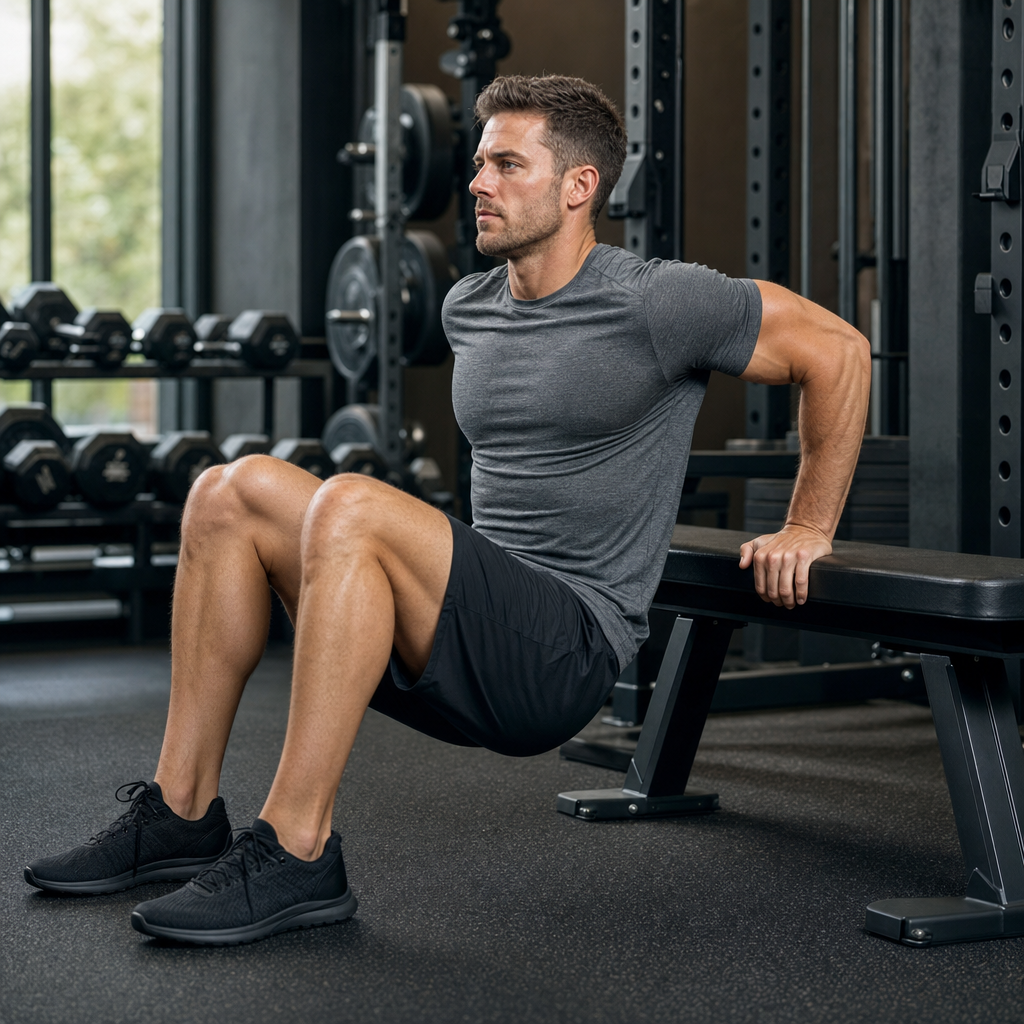
If you are brand new to dips, start with the bench dip and progress to parallel bars as soon as you can. Here is the exact sequence for both variations.
Bench Dip — Step by Step (Beginner)
Step 1 — Setup: Sit on the edge of a sturdy bench or chair. Place your hands next to your hips, fingers wrapping over the edge of the bench, pointing toward your feet. Slide your hips forward off the bench until your weight is supported by your arms.
Step 2 — Foot position: For the easiest version, keep your knees bent at 90 degrees with feet flat on the floor close to the bench. To progress, walk your feet further out so your legs are straighter. The hardest bench dip places the heels on an elevated platform (a second bench or low box) directly across from the support bench.
Step 3 — Descend: Keeping your chest up and your back close to the bench, bend your elbows straight back (not flared outward) and lower your hips toward the floor. Stop when your upper arms are parallel to the floor — going deeper stresses the front of the shoulder capsule.
Step 4 — Press up: Push through your palms and extend your elbows back to the starting position. Do not lock the elbows aggressively at the top; a soft lockout keeps tension on the triceps. Aim for 2 seconds down, 1 second pause at the bottom, 1 second up.
Parallel Bar Dip — Step by Step (Intermediate to Advanced)
Step 1 — Mount the bars: Grip a set of parallel dip bars (shoulder-width or slightly wider). Press up to the top position with arms straight, body suspended between the bars, shoulders packed down and away from your ears.
Step 2 — Set torso angle: For a tricep-focused dip, keep your torso as vertical as possible and bring your feet directly underneath your hips. For a chest-focused dip, lean your torso forward 30-45 degrees and let your feet drift slightly behind you. Decide your angle before you start the rep — switching mid-rep makes the movement sloppy.
Step 3 — Descend with control: Bend your elbows and lower your body. Keep your elbows tracking slightly back (for upright) or slightly out (for forward lean) — never let them flare straight to the sides. Lower until your shoulders are roughly level with your elbows, or stop slightly earlier if you feel pinching in the front of the shoulder. In my experience coaching dozens of trainees, the "parallel arms" cue (upper arm parallel to the floor) is the safest depth target.
Step 4 — Press to lockout: Drive through your palms and squeeze the triceps to extend the elbows. At the top, squeeze your chest if you are doing a chest-focused dip, or hold a slight bend at the top if you are doing the tricep-focused version. Breathe out on the way up.
For step-by-step structured progression markup, this guide follows the standard HowTo pattern — moving from setup through execution with measurable end states (parallel arms, full lockout).
Chest Dips vs Tricep Dips: How Does Torso Lean Change the Target?
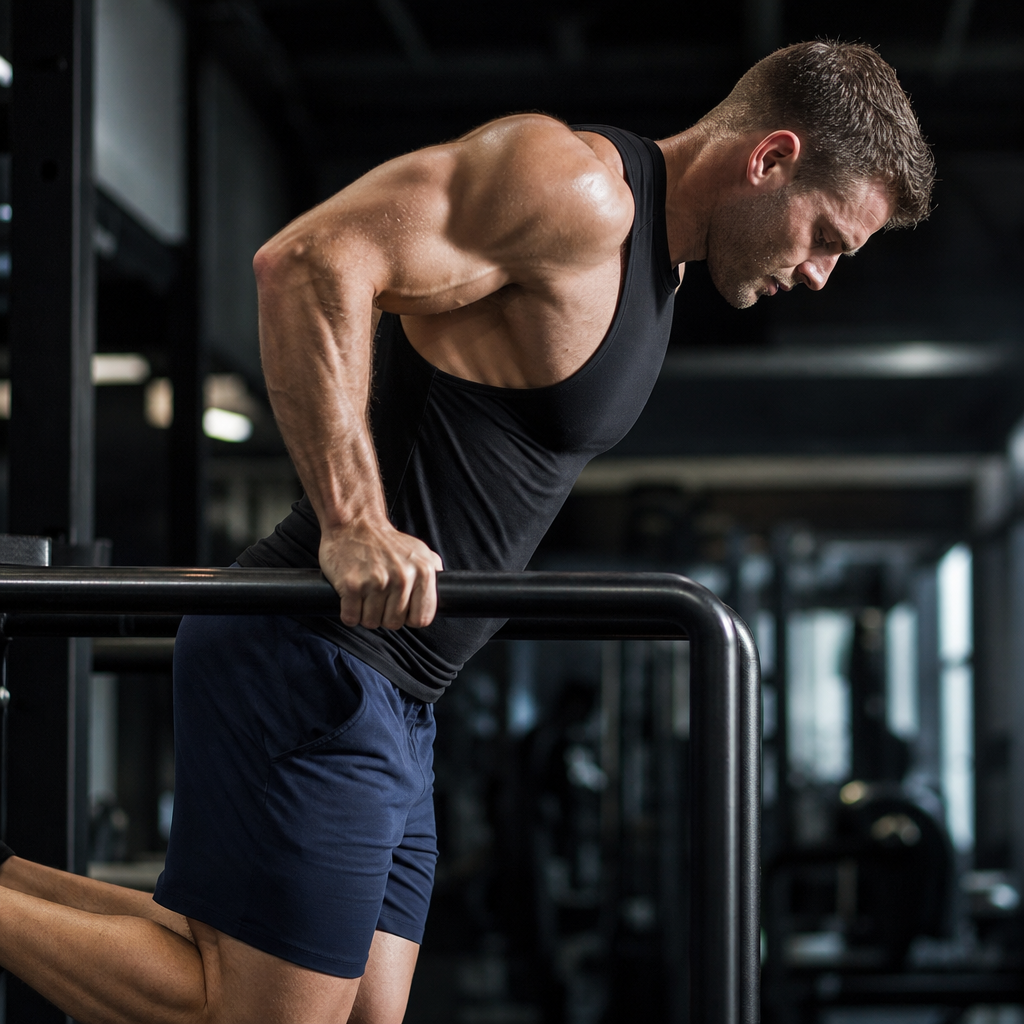
One question I get constantly is "should I do chest dips or tricep dips?" The honest answer is: both, depending on your goal that day. The exercise is identical — the angle of your torso determines which muscle does the most work.
| Torso Angle | Elbow Path | Primary Muscle (~%) | Secondary Muscle (~%) |
|---|---|---|---|
| Vertical (0° lean) | Tucked close to ribs | Triceps (~70%) | Anterior delt (~20%) |
| Slight lean (15°) | Tucked, slight back drift | Triceps (~55%) | Lower chest (~30%) |
| Moderate lean (30°) | Slight flare allowed | Lower chest (~50%) | Triceps (~35%) |
| Heavy lean (45°+) | Wider, flared outward | Lower chest (~65%) | Triceps (~25%) |
Note: percentages are illustrative based on EMG literature and reflect the general loading pattern, not exact values for every individual.
Programming Both Variations
Within a single weekly training split, you can absolutely use both:
- Push day A (chest focus): Forward-lean parallel bar dips — 3-4 sets of 8-12 reps
- Push day B (arm focus): Upright parallel bar dips — 3-4 sets of 10-15 reps
If you are training each muscle group twice per week, alternating the lean angle gives you targeted stimulus for both muscles without repeating the exact same exercise. This is more efficient than treating "chest dip" and "tricep dip" as two completely separate moves.
For comparison with the horizontal pushing pattern, the standard push-up loads the chest with the body parallel to the floor and emphasizes scapular protraction — a fundamentally different stimulus than the suspended, vertical-push nature of dips.
What Are the Most Common Dips Mistakes?

Dips look simple, but most lifters I have coached make at least one of these five mistakes — and over months these errors compound into elbow tendinitis, anterior shoulder pain, or just stalled progress. Fix them before they cost you.
1. Elbow flare (wings spread): Letting your elbows shoot out 90 degrees to the sides — especially common when fatigued — places massive shear stress on the elbow joint and shoulder capsule. Fix: For tricep-focused dips, tuck the elbows tight to the ribs. For chest-focused dips, allow only a slight outward angle (about 30 degrees from the body). Never go fully horizontal.
2. Shoulder shrug (ears meeting shoulders): When you lose scapular control, your shoulders ride up toward your ears at the bottom of the rep, pinching the rotator cuff against the acromion. Fix: Before every set, actively pull your shoulder blades down and back as if tucking them into your back pockets. Keep that position throughout the rep — if you cannot maintain it, the weight (your bodyweight) is currently too heavy and you need an assisted variation.
3. Partial range of motion (half reps): Stopping with the elbows still well above 90 degrees of flexion shortcuts the triceps and chest stretch — you get a fraction of the benefit. Fix: Lower until your upper arms are parallel to the floor. Use a mirror or film yourself from the side to check depth honestly.
4. Going too deep (shoulders dropping below elbows): The opposite extreme — sinking until your shoulders are well below your elbows — overloads the anterior shoulder capsule. This is the single most common cause of dip-related shoulder pain. Fix: Stop at parallel. If your shoulder feels "pinched" at the bottom, you are going too deep.
5. Swinging and kipping: Using leg momentum to bounce yourself up turns a strength exercise into cardio. Fix: Cross your ankles and squeeze your glutes to lock your body into a rigid lever. The legs should hang dead still throughout the rep. If you cannot do a strict rep, do a slow eccentric (5-second lowering) instead — it builds strength faster than swinging through full reps.
What Are the Key Takeaways?
| Point | Recommendation |
|---|---|
| Primary muscles | Triceps (87%+ MVC), lower chest, anterior delts |
| Beginner version | Bench dip — feet on floor, knees bent |
| Standard version | Parallel bar dip — body suspended, arms locked at top |
| Tricep emphasis | Vertical torso, elbows tucked tight |
| Chest emphasis | 30-45° forward lean, elbows slightly flared |
| Depth | Upper arms parallel to floor — no deeper |
| Frequency | 2-3 sessions per week, 48+ hours between |
Quick checklist — fix these before your next set:
- Shoulders packed down and back — never shrugging to the ears
- Elbows tracking back (tricep version) or 30° out (chest version) — never flared 90°
- Stop descent at upper-arm parallel — do not sink lower
- Legs locked still, no swinging or kipping
- Full lockout at the top, but no aggressive elbow snap
Next steps: If you cannot yet do a single parallel bar dip, build the foundation with 3 sets of 8-12 bench dips and 3 sets of 5 slow eccentric parallel bar dips (jump to the top, lower for 5 seconds) twice per week. Most trainees clear their first clean parallel bar dip within 4-6 weeks. For the horizontal pushing counterpart, see our push-up article for comparison. Once you can perform 12+ strict parallel bar dips, progress to weighted dips with a dip belt, or move to dumbbell triceps exercises for direct arm hypertrophy work.
Frequently Asked Questions
What muscles do dips work?
Dips primarily target the triceps brachii (back of upper arms), with significant activation of the lower pectoralis major (lower chest) and the anterior deltoids (front shoulders). A 2014 EMG study in the Journal of Strength and Conditioning Research found that parallel bar dips activate the triceps at over 87% of maximum voluntary contraction. The exact emphasis shifts based on torso lean — vertical torso favors triceps, forward lean shifts work to the chest.
Are dips bad for your shoulders?
Dips are safe for healthy shoulders when performed with good form, but they can aggravate existing shoulder issues. The risk comes from descending too deep (below 90 degrees at the elbow) which stresses the anterior capsule of the shoulder joint, and from shrugging the shoulders up toward the ears. Keep your shoulders packed down and away from your ears, and stop your descent when your upper arms reach parallel to the floor. If you have a history of impingement or rotator cuff issues, start with bench dips before progressing to parallel bars.
How many dips should I be able to do?
For beginners, working up to 5-8 clean parallel bar dips is a solid milestone. Intermediate lifters should aim for 12-15 reps. Advanced trainees can perform 20+ bodyweight dips and progress to weighted dips with a dip belt. If you cannot do a single parallel bar dip yet, start with bench dips and negative dips (slowly lowering yourself) to build the foundational strength.
Bench dips vs parallel bar dips — which is better?
They serve different purposes. Bench dips (feet on floor, hands on bench behind you) are easier and a great starting point, but they place the shoulder in an internally rotated position that some lifters find uncomfortable. Parallel bar dips (body suspended between two bars) are harder, allow a more natural shoulder position, and engage more muscle mass — making them the superior long-term choice. Start with bench dips if you cannot do parallel bar dips yet, then progress as soon as possible.
Can I do dips every day?
It is not recommended. The triceps, chest, and anterior deltoids need 48-72 hours of recovery between heavy training sessions. Daily dips often lead to elbow tendinitis and shoulder overuse. Train dips 2-3 times per week with adequate rest, and you will progress faster than someone grinding them out daily.
References & Sources
TDEE Calculator (Daily Calories)
Calculate your Total Daily Energy Expenditure (TDEE) - the number of calories you burn each day. The calculator uses the Mifflin-St Jeor equation for your basal metabolic rate, multiplied by your activity level.
Protein Intake Calculator
Calculate how much protein you need each day based on your body weight and training goal. This calculator uses the research-backed range of 1.6 to 2.2 grams of protein per kilogram of body weight for building muscle.