
Resistance Band Chest Exercises: 8 Best Moves for Home & Travel
Resistance-band chest training builds the pectorals with portable, joint-friendly resistance. Anchor a band at chest height behind you, hold a handle in each hand, and press or fly your hands forward until they meet in front of your chest, squeezing your pecs, then return slowly against the band's tension.
Why Train Your Chest with Resistance Bands?
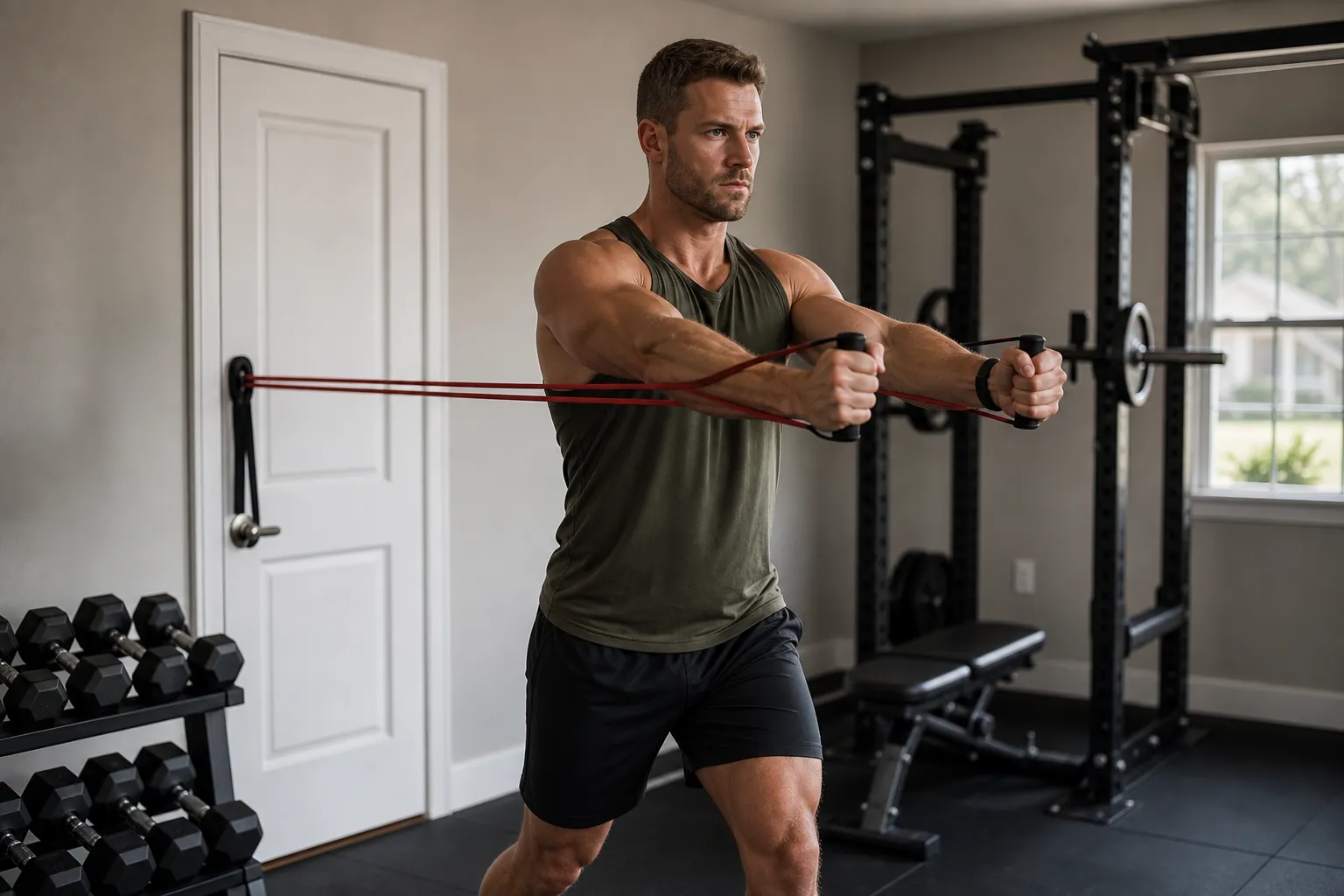
Resistance bands are one of the most underrated tools for building a bigger, stronger chest. They cost a fraction of a gym membership, pack down to the size of a water bottle, and deliver something dumbbells and barbells cannot: accommodating resistance. The farther you press, the harder the band pulls. At the lockout — where a dumbbell press is easiest — a band press is hardest. This matches your natural strength curve and keeps your chest under tension through every inch of the movement.
The chest is uniquely suited to band training because its primary function — horizontal adduction (bringing your arms together in front of your body) — can be replicated perfectly with a band anchored behind you. A 2019 study in the Journal of Human Kinetics compared EMG activity in the pectoralis major during resistance band chest press versus dumbbell bench press and found that the two exercises produced comparable muscle activation, particularly in the sternal (lower) portion of the chest.
Muscles Targeted
Resistance band chest exercises primarily work the same muscles as their free-weight counterparts:
- Pectoralis major (upper, sternal, lower fibers): The main chest muscle — pressing movements target the sternal and lower fibers; incline angles shift emphasis to the upper (clavicular) head.
- Serratus anterior: Controls scapular protraction at the top of pressing movements; essential for full shoulder health and a well-rounded physique.
- Scapular stabilizers (rhomboids, middle/lower traps): Keep your shoulders packed and stable throughout every rep; bands demand more scapular control than machines because you must stabilize the load yourself.
In my experience training clients at home and in commercial gyms, bands shine brightest for three specific scenarios: travel (zero setup, fits in luggage), joint sensitivity (smooth tension curve spares stressed shoulders and elbows), and as a push-day finisher after heavy barbell work to pump blood into the chest without loading the joints further.
How to Perform the 8 Best Resistance Band Chest Exercises
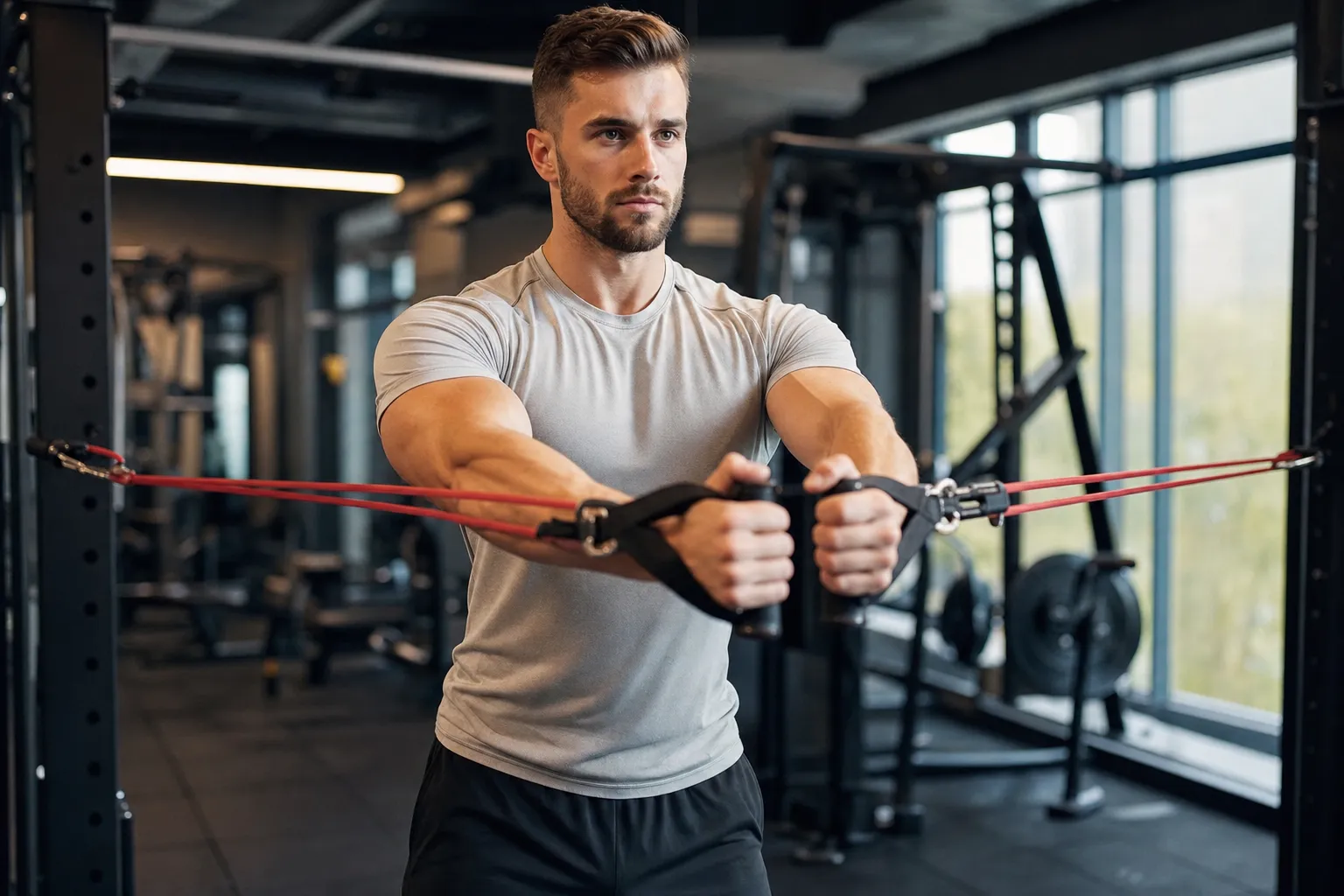
These eight exercises cover every angle of chest development. Below is an overview table, followed by detailed instructions for the three most essential moves.
| Exercise | Angle | Primary Target | Anchor Height |
|---|---|---|---|
| Standing band chest press | Flat | Pec major (sternal) | Shoulder height |
| Incline band press | Incline | Upper pec (clavicular) | Low (waist height) |
| Band fly | Flat / incline | Pec major (stretch focus) | Shoulder height |
| Band push-up | Flat | Full chest + core | Band across back, no anchor |
| Single-arm band press | Flat | Unilateral chest + anti-rotation core | Shoulder height |
| Band crossover | Decline angle | Lower pec + serratus | High (above head) |
| Decline band press | Decline | Lower pec | Low (waist height, anchor below) |
| Band pullover | Flat | Pec major + lats | Low (anchor at floor level) |
1. Standing Band Chest Press — The Foundation
Anchor the band at shoulder height behind you (door anchor works best). Stand facing away from the anchor, holding one handle in each hand at chest height. Walk forward until you feel moderate tension. Press both handles forward until your arms are fully extended, squeezing your chest at lockout. Control the return, stopping just before the band goes slack. Perform 3 sets of 10–15 reps.
2. Band Fly — The Stretch
Same setup as the chest press — anchor at shoulder height, face away. Instead of pressing, start with your arms wide and slightly bent (about 15 degrees of elbow flexion that stays fixed throughout). Bring your hands together in a wide arc in front of your chest, feeling the deep stretch at the back and the contraction at the front. The fly does not need heavy bands; light-to-medium resistance for 12–15 controlled reps builds an incredible mind-muscle connection with the chest.
3. Band Push-Up — The Compound
Loop a band across your upper back and hold the ends under your palms in a push-up position. The band adds resistance at the top of the push-up (where bodyweight push-ups are easiest), forcing your chest and triceps to work harder through the full range. Perform 3 sets to failure or near-failure — the accommodating resistance makes even high-rep sets productive.
The remaining five — incline band press (anchor low, press up at a 45-degree angle), single-arm band press (great for correcting left-right imbalances), band crossover (anchor high, pull down and across), decline band press (anchor at floor level, press from a decline push-up position), and band pullover (anchor at floor, pull from behind head to thighs) — all follow the same principles with adjusted angles and anchor points.
How Do You Anchor a Resistance Band at Home or While Traveling?
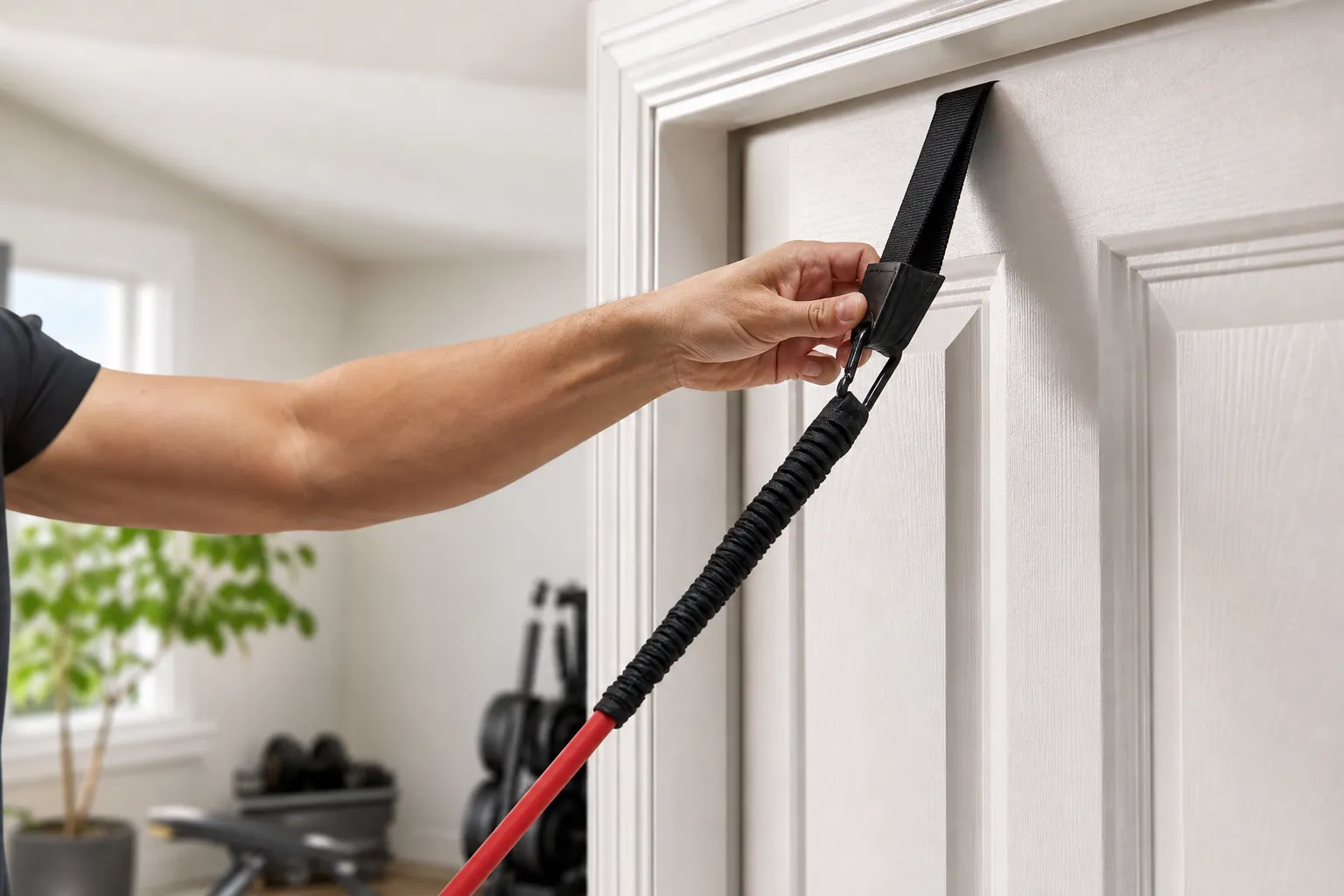
Anchoring is the single most important practical skill for band training. A bad anchor ruins the exercise. Here is how to set up anywhere:
| Anchor Method | Best For | Setup Time | Notes |
|---|---|---|---|
| Door anchor | Chest press, fly, crossover | 10 seconds | Place the stopper on the opposite side of the door from where you train; close the door firmly. Works for shoulder-height, low, and high setups depending on door hinge position. |
| Behind-back pass | Chest press (no anchor) | 5 seconds | Loop the band behind your upper back and grasp each end at chest height. Press forward. No anchor needed — the band pinning against your back replaces it. Best for quick sets and travel with zero gear. |
| Pole / banister wrap | All exercises | 15 seconds | Loop the band around a sturdy vertical or horizontal pole. Works best for low anchors (pullovers) and high anchors (crossovers). Test stability before each set — loose poles or coat racks will tip. |
| Heavy furniture leg | Low anchors | 10 seconds | Wrap around a solid table or desk leg. Only use for exercises where force pulls away from the anchor (pullovers, decline press). |
Anchor height quick guide: Low anchor (waist or below) shifts emphasis to the upper chest. Shoulder-height anchor is the standard flat-press position. High anchor (above your head) targets the lower chest and serratus through a downward pressing angle. For travel, I pack a single door anchor and a medium band — that covers every chest exercise in this article and fits in the outer pocket of a carry-on.
What Are the Most Common Resistance Band Chest Mistakes?
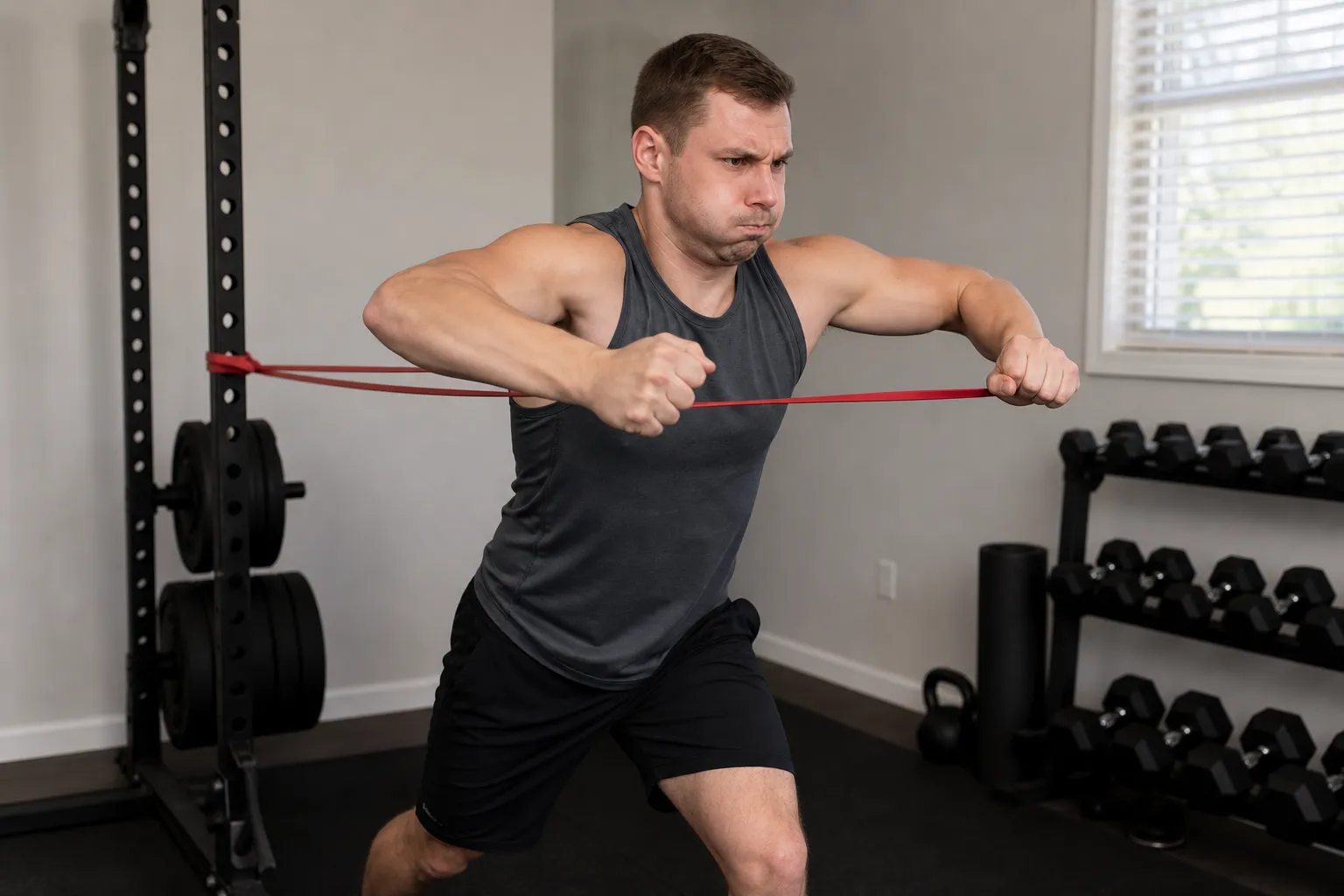
Band training looks deceptively simple. After coaching hundreds of band-training sessions, these are the mistakes I correct most often:
1. Letting the band go slack at the back of the movement. The entire advantage of bands — constant tension — disappears the moment the band relaxes. Stand far enough from the anchor that the band remains stretched even at the starting position. If you feel a "dead spot" at the back, step farther forward.
2. Elbow flare (elbows pointing out at 90 degrees to the torso). Flared elbows shift stress from the chest to the shoulder joint and rotator cuff. Keep your elbows at roughly 45–60 degrees from your torso, as you would with a dumbbell press. This protects your shoulders and keeps the tension on your pecs.
3. Losing scapular retraction. Your shoulder blades should stay pinched together throughout the movement, just like in a barbell bench press. If your shoulders roll forward at any point, you lose the stable base your chest needs to produce force. Reset your scapular position before every rep if needed.
4. Using the wrong band tension. Bands that are too light let you rattle off 25+ reps with zero chest engagement. Bands that are too heavy cause compensations — leaning forward, using momentum, shrugging the shoulders. The sweet spot is a band that makes 10–12 controlled reps genuinely challenging on the last 2–3 reps.
5. Anchor at the wrong height for the intended movement. A chest press with the anchor at your knees becomes a low-to-high press that emphasizes the front delts and upper chest — not inherently wrong, but not a flat chest press. Match your anchor height to your target: shoulder height for flat, waist height for incline, above head for decline.
6. Snap-back lockouts. Letting the band snap you back to the start position after each rep is a fast way to bruise your arms and miss half the eccentric stimulus. Control the return in 2–3 seconds. The eccentric (lowering) phase is where bands do some of their best muscle-building work.
What Are the Key Takeaways?
| Point | Recommendation |
|---|---|
| Primary muscles | Pec major (upper, sternal, lower), serratus anterior, scapular stabilizers |
| Anchor priority | Shoulder height for presses, low for incline/upper chest, high for lower chest |
| Band tension | Medium to heavy (20–50 lbs) for main work; light (10–15 lbs) for flies and warm-up |
| Sets & reps | 3–4 sets of 10–15 reps with controlled tempo (2s concentric, 2–3s eccentric) |
| Top 3 exercises | Standing band chest press, band fly, band push-up |
Quick checklist — run through these before every chest session:
- Band is under tension at the starting position (no slack)
- Elbows at 45–60 degrees — not flared
- Scapulae retracted and stable throughout
- Band tension challenges you within 8–15 reps
- Anchor height matches the intended angle
- Controlled eccentric of 2–3 seconds on every rep
Next steps: Start with the standing band chest press and band fly as your core pair — 3 sets of 12 reps each, three times per week. Once you can complete all sets with clean form, progress by decreasing your rest intervals, using a heavier band, or adding the band push-up as a finisher. For a complete home training system, pair these exercises with core resistance band training and dumbbell chest exercises when you have access to weights. To keep your chest growing over time, apply progressive overload principles — increase band tension, volume, or time under tension every 2–3 weeks.
Frequently Asked Questions
Can you build chest muscle with resistance bands?
Yes — resistance bands provide enough tension to stimulate muscle growth in the chest, especially when you use proper form, progressive overload (moving to heavier bands or higher tension), and a full range of motion. A 2019 study in the Journal of Human Kinetics found that the resistance band chest press produced comparable EMG activation in the pectoralis major to dumbbell bench press. The key difference is accommodating resistance: bands get harder as you press out, matching your natural strength curve.
What is the best resistance band chest exercise?
The standing band chest press is the most versatile because it requires no bench and works both pecs and stabilizers simultaneously. For isolation, the band fly targets the chest with a deep stretch at the back of the movement. For overall development, combining the band chest press, band fly, and band push-up gives you full pec coverage across all angles and tension zones.
What resistance band tension should I use for chest?
For chest exercises, medium to heavy bands (20–50 lbs resistance at full stretch) are typically appropriate for most lifters. Lighter bands (10–15 lbs) work well for warm-ups, flies, and high-rep finishers. The right tension lets you complete 8–15 reps with controlled form — if you can do 20+ reps easily, size up to a heavier band.
How do you anchor a resistance band for chest exercises at home?
The most common method is a door anchor: a small fabric or rubber stopper placed between the door and the frame, secured with the door closed behind you. You can also loop the band around a sturdy pole, banister, or heavy furniture leg. For chest exercises, shoulder-height anchoring works best for presses, while mid-chest height is ideal for flies.
Are resistance bands better than dumbbells for chest?
Not "better" — different. Bands excel where dumbbells fall short: accommodating resistance (harder at lockout), portability (fit in a backpack), joint-friendly tension curves, and constant time under tension. Dumbbells offer fixed resistance that is easier to load precisely and measure progress in absolute terms. For most people, a combined approach — dumbbells for heavy strength work, bands for volume, finishers, and travel — yields the best results.
References & Sources
1RM Calculator (One-Rep Max)
Estimate your one-rep max (1RM) - the maximum weight you can lift for a single repetition - from a weight you can lift for multiple reps. The calculator uses the Epley and Brzycki equations and averages them.
Strength Standards Calculator
How strong are you compared to other lifters? Enter your bodyweight and best lift to see where you rank - from Beginner to Elite - on the bench press, squat, deadlift, and overhead press. Standards are scaled to your bodyweight, so a 60 kg lifter and a 100 kg lifter are judged fairly.
Protein Intake Calculator
Calculate how much protein you need each day based on your body weight and training goal. This calculator uses the research-backed range of 1.6 to 2.2 grams of protein per kilogram of body weight for building muscle.