
How to Do Mountain Climbers: Form Guide, Muscles & Variations
Mountain climbers are a dynamic cardio and core exercise. Start in a plank position with hands under your shoulders, brace your core, and alternately drive your knees toward your chest at a quick pace, keeping your hips down and back flat. They raise your heart rate while training the abs, shoulders, and hip flexors.
Why Mountain Climbers Are the Ultimate Core-and-Cardio Move

The mountain climber is the rare bodyweight exercise that trains your core and your conditioning at the same time. You hold a plank - the gold standard for core stability - while driving your knees in alternation, which forces the abs, shoulders, hip flexors, and heart to all work simultaneously. No other zero-equipment movement delivers this much midline tension per minute of heart-rate work.
A 2018 EMG analysis published in the Journal of Strength and Conditioning Research found that the mountain climber produced over 90% of the core activation of a hollow-body hold (one of the hardest abdominal isometrics), while also elevating heart rate to roughly 85% of age-predicted maximum in trained subjects. In plain terms: you get the abs of a static hold and the cardio of a sprint, compressed into a single 30-second interval.
Muscles Worked
The movement is plank-based, so the recruitment list reads like a core-training anatomy chart:
- Core: Rectus abdominis (six-pack), obliques (rotation resist), transverse abdominis (bracing) - all fire continuously to hold the plank against the anti-rotation challenge of alternating knees
- Shoulders and chest: Deltoids, pectoralis major, serratus anterior - stabilize the upper body against the driving legs
- Triceps: Hold the straight-arm plank position, working isometrically
- Quads and hip flexors: Drive the knee toward the chest, working concentrically on the pull and eccentrically on the return
- Glutes and hamstrings: Co-contract to keep the hips level and prevent the piked-hip position
The deeper value is anti-rotation. Every time you drive one knee in, your torso wants to twist toward that side. Resisting that twist is what makes the mountain climber harder than a standard plank - your obliques and transverse abdominis have to fire forcefully on every single rep to keep your hips square. For a deeper dive into why anti-rotation matters, see our core training guide.
How to Do the Mountain Climber with Proper Form
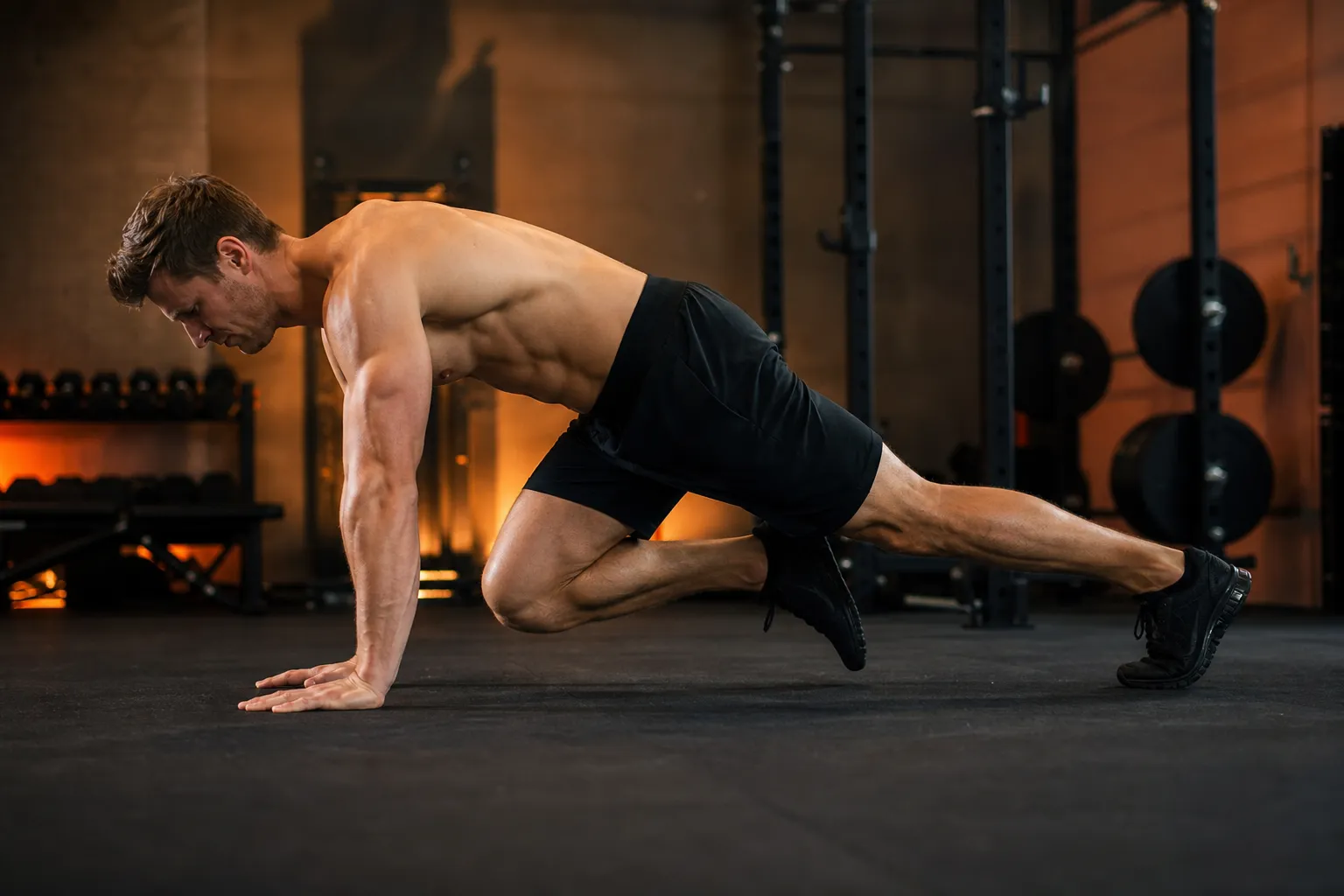
The mountain climber looks simple, but clean form is the difference between a core exercise and a hip-flexor pump. Master the positions before adding speed.
Step 1 - Set up the plank: Start in a high plank (push-up) position with your hands directly under your shoulders, arms straight, and your body forming a straight line from the back of your head to your heels. Screw your palms into the floor as if turning a doorknob outward - this engages your lats and stabilizes the shoulder joint. Brace your core as if expecting a punch to the stomach. Squeeze your glutes. Your hips should be level with your shoulders, not piked up toward the ceiling or sagging toward the floor.
Step 2 - Drive one knee in: Without raising your hips or rounding your lower back, lift your right foot and draw your right knee toward your chest. The knee should track toward the chest, not toward the opposite elbow - crossing the midline is a different variation (cross-body mountain climber). Keep your right foot off the floor at the top of the movement. Your left leg stays straight and strong, with the glute engaged. Hold this position for a half-second to confirm your hips have not risen.
Step 3 - Return and alternate: Extend your right leg back to the starting plank position with control - do not let it drop. The moment your right foot touches down, drive your left knee in toward your chest using the same mechanics. This is one full rep. The transition between legs should be smooth, with no pause at the bottom and no hip bounce. Your shoulders stay stacked over your wrists the entire time.
Step 4 - Breathe and tempo: Exhale forcefully through pursed lips as each knee drives in; inhale on the return. Start at a controlled tempo of roughly one knee every second (about 30 reps per 30-second interval). Speed comes later - according to the American College of Sports Medicine, the mountain climber is most effective for core training at 50-70% of maximum speed, where the abs can still control the anti-rotation demand. Faster than that, and the movement becomes hip-flexor-driven rather than core-driven.
In my experience coaching this movement, the single most valuable cue is "quiet hips." If your hips are bouncing up and down with each knee drive, you have lost core tension and the exercise has stopped being a core movement. Reset and slow down.
Mountain Climber Variations for Every Fitness Level

The standard mountain climber is intermediate difficulty - it requires the shoulder stability to hold a plank and the core control to resist rotation. Use these variations to scale down if you are building the foundation, or to scale up once the standard version feels easy.
| Variation | Difficulty | What's Modified | Who It's For |
|---|---|---|---|
| Slow mountain climber | Beginner | One knee in at a time, 2-second hold at top | Building plank endurance |
| Incline mountain climber | Beginner | Hands on bench or wall, reduces core load | Shoulder or core weakness |
| Standard mountain climber | Intermediate | Alternating knees at moderate pace on the floor | Baseline for conditioned athletes |
| Cross-body mountain climber | Intermediate-Advanced | Knee drives to opposite elbow, adds rotation | Oblique development |
| Spider mountain climber | Advanced | Knee drives outside the elbow, deep hip flexion | Advanced mobility and strength |
Progression strategy: If you cannot hold a high plank for 30 seconds with perfect form, start with the incline variation - hands on a bench or against a wall. This reduces the percentage of bodyweight your shoulders and core must support, letting you learn the knee-drive pattern safely. Once you can do 30 seconds of slow mountain climbers on the floor without your hips sagging, progress to the standard pace.
The cross-body variation is the next step after the standard version feels easy. Driving the knee to the opposite elbow forces your obliques to control a much larger rotational force, which is why it is the best variation for visual ab development - the obliques frame the rectus abdominis and create the "V-taper" look. The spider variation is the final progression: the knee drives outside the same-side elbow, demanding deep hip flexion and significant anti-rotation strength. Reserve it for athletes who have been doing standard mountain climbers for at least 4-6 weeks.
The Most Common Mountain Climber Mistakes

Mountain climbers become ineffective - and sometimes painful - when form breaks down. These are the four mistakes that ruin the movement, ranked by how often I see them.
1. Piking the hips up: The most common error. When fatigue sets in, the hips rise toward the ceiling, turning the movement into a downward-dog-to-knee-tuck. This offloads the core and shifts the work entirely to the hip flexors and shoulders. Fix: Reset your plank before every set - shoulders over wrists, hips in line with shoulders. If your hips drift up during the set, pause and reset rather than pushing through with bad form.
2. Bouncing hips: Each knee drive should be independent. If your whole body bounces up and down with each rep, you are using momentum instead of muscle. The bounce is usually a sign you are going too fast or your core has run out of tension. Fix: Slow down to one knee every two seconds. If the bounce persists, your core is fatigued and the set should end.
3. Hands in front of the shoulders: Walking the hands forward of the shoulders reduces the load on the core (it becomes easier, like an incline plank) but also shifts excess load onto the shoulder joints. Fix: Before every set, glance down and confirm your wrists are directly under your shoulders. This is the position of maximum mechanical advantage for both the core and the shoulders.
4. Holding the breath: The mountain climber is intense, and many athletes unconsciously hold their breath to brace harder. This spikes blood pressure and reduces the number of reps you can do before core failure. Fix: Force an exhale with each knee drive - this naturally cycles your breath and reinforces the brace. A simple cue: "hiss on the drive." If you cannot talk in short bursts during the set, you are holding your breath.
Avoid these four errors and the mountain climber becomes one of the safest, most scalable conditioning exercises you can do. For a related movement that builds the plank foundation mountain climbers require, see our plank form guide.
What Are the Key Takeaways
| Point | Recommendation |
|---|---|
| Muscle groups | Core-dominant - rectus abdominis, obliques, transverse abdominis - plus shoulders, triceps, quads, hip flexors |
| Setup | High plank, wrists under shoulders, hips level with shoulders, glutes squeezed |
| Tempo | One knee per second at 50-70% max speed - quiet hips beat fast bouncing |
| Breathing | Exhale on each knee drive - never hold your breath |
| Progression | Incline -> Slow -> Standard -> Cross-body -> Spider |
Quick mistake checklist - fix these before your next mountain climber session:
- Hips piking up toward the ceiling - reset your plank before every set
- Hips bouncing with each rep - slow down to one knee every two seconds
- Hands walking forward of shoulders - stack wrists directly under shoulders
- Holding your breath - exhale sharply on every knee drive
- Going too fast to control rotation - speed without control is hip-flexor work, not core work
Next steps: If you have never done mountain climbers, start with 3 sets of 20-second slow intervals (one knee every two seconds) three times per week. Add 5 seconds per week until you reach 45 seconds, then progress to the standard pace. For a complete conditioning circuit, pair mountain climbers with burpees and push-ups - 30 seconds of each, 4 rounds, rest 60 seconds between rounds. This combination hits every major muscle group and elevates heart rate enough to count as a full cardio session by ACSM cardio guidelines.
Frequently Asked Questions
What muscles do mountain climbers work?
Mountain climbers primarily target the rectus abdominis, obliques, and transverse abdominis (core), with significant work from the shoulders (deltoids), chest (pectoralis major), triceps, quadriceps, and hip flexors. Because you hold a plank position while driving the knees, the deep stabilizers fire continuously. A 2018 EMG analysis in the Journal of Strength and Conditioning Research found mountain climbers produced over 90% of the core activation of a hollow-body hold, plus far more cardiovascular demand.
How many calories do mountain climbers burn?
Mountain climbers burn roughly 8-12 calories per minute at a moderate pace and up to 15 calories per minute at high intensity, depending on your body weight and effort. A 70 kg (155 lb) person can expect to burn about 10 calories per minute. This places mountain climbers among the highest calorie-burning bodyweight exercises, behind only burpees and squat jumps for metabolic cost per minute.
Are mountain climbers bad for your lower back?
No, when performed with proper form. The danger comes from letting the hips sag or pike up during the movement, which transfers the load from the abs to the lumbar spine. To protect your back, brace your core as if expecting a punch, keep your hips level with your shoulders, and avoid bouncing. If you feel your lower back arching, stop and reset. People with existing disc issues should start with slow, controlled reps rather than high-speed intervals.
How long should I do mountain climbers?
For beginners, 20-30 seconds of work followed by 30-60 seconds of rest, repeated for 5-8 rounds, is a solid starting point. Intermediate trainees can progress to 40 seconds on, 20 seconds off for 8-10 rounds. Advanced athletes often use Tabata intervals - 20 seconds of maximum effort, 10 seconds of rest, repeated 8 times for 4 minutes total. Quality matters more than duration: 30 seconds of clean, controlled reps beats 60 seconds of sloppy bouncing.
Mountain climbers vs burpees - which is better?
They serve different purposes. Burpees burn more calories per minute (roughly 12-15 vs 8-12) because they include a push-up and vertical jump, making them a more complete full-body movement. Mountain climbers are gentler on the joints, easier to scale for beginners, and better for sustained core training without the impact of jumping. For general conditioning, alternate both: burpees for maximum metabolic demand, mountain climbers for core-focused intervals between strength sets.
References & Sources
TDEE Calculator (Daily Calories)
Calculate your Total Daily Energy Expenditure (TDEE) - the number of calories you burn each day. The calculator uses the Mifflin-St Jeor equation for your basal metabolic rate, multiplied by your activity level.
Protein Intake Calculator
Calculate how much protein you need each day based on your body weight and training goal. This calculator uses the research-backed range of 1.6 to 2.2 grams of protein per kilogram of body weight for building muscle.