
How to Do Sit Ups: Form Guide, Muscles Worked & the Back-Safety Truth
Sit-ups are a full-range core exercise. Lie on your back with knees bent and feet flat, engage your abs to curl your torso all the way up to a sitting position, then lower back down with control. Keep your hands light behind your ears, exhale as you rise, and stop if your lower back arches off the floor.
Why Sit Ups Still Have a Place in Core Training

Sit-ups have taken a beating in the press. The US Army dropped them from its fitness test in favor of the plank, physiotherapists warn about spinal compression, and half the internet declares them dead. Yet walk into any martial arts gym, wrestling room, or military training unit and you will still find people doing them by the hundreds. Both camps are working from real facts - the disagreement is about context.
What sit-ups do well is train the entire trunk-flexion pattern: your abs curl the spine up, your hip flexors drive the torso the rest of the way, and your core controls the descent. That is the same sequence you use to get off the floor, to spring up from a guard in grappling, and to hold position in contact sports. No isolation exercise covers that full arc.
Three benefits keep sit-ups relevant:
- Full-range ab work: the rectus abdominis works through a longer range than any crunch allows.
- Functional hip-flexor strength: the iliopsoas is trained the way sport actually uses it - lifting the trunk against bodyweight.
- Zero equipment and easy programming: a mat and a floor are the whole setup, which makes them ideal for home circuits alongside mountain climbers and planks.
The honest caveat: sit-ups are not the best tool for everyone, and doing them badly at high volume can genuinely bother your back. This guide covers the form, the muscles (including the hip-flexor truth most guides skip), the sit-up vs crunch decision, and how to keep your spine happy.
How to Do Sit Ups with Perfect Form
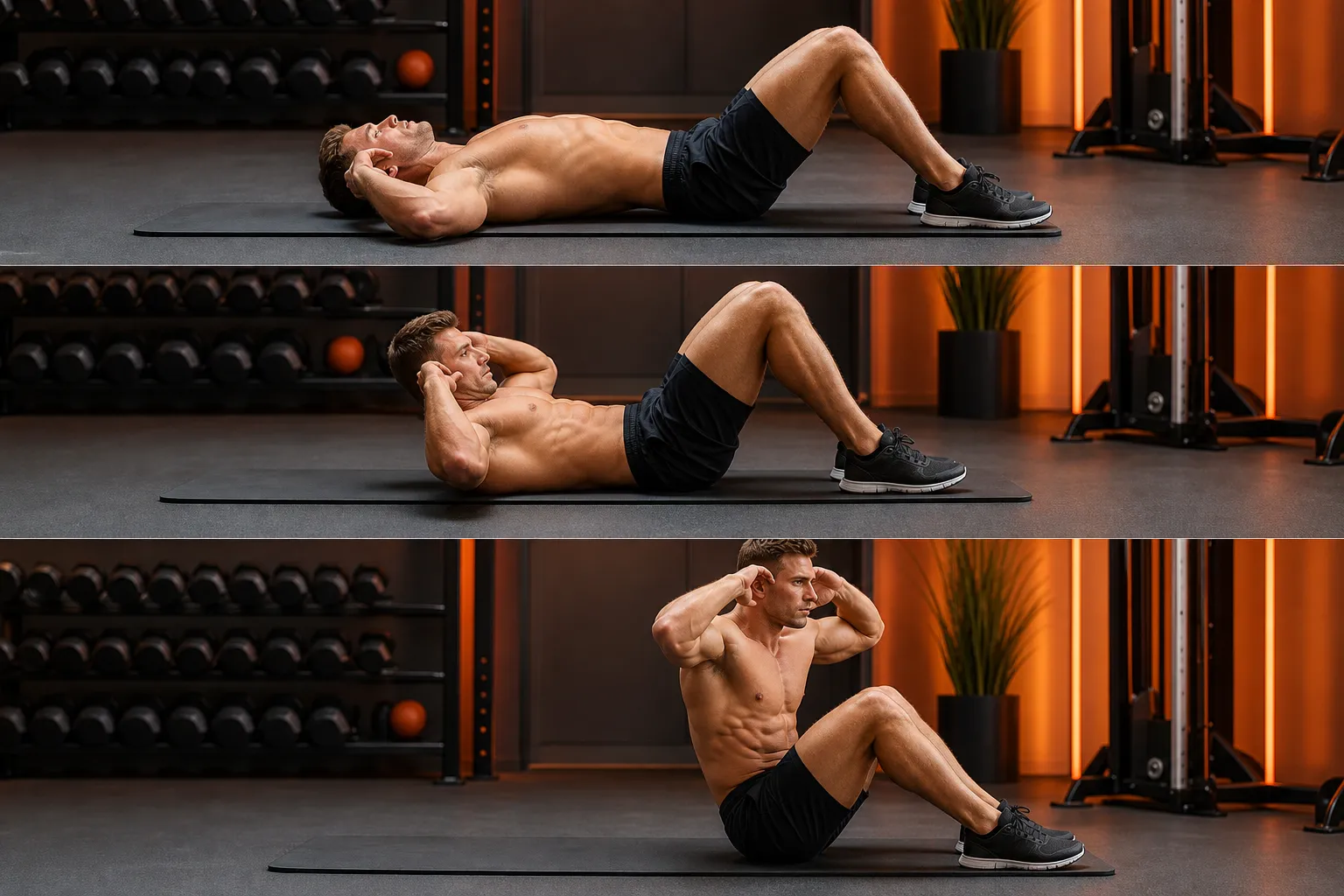
The sit-up looks like gym-class simplicity, which is exactly why most people do it with yanked necks and bouncing feet. Here is the breakdown, floor to finish.
Step 1 - Setup: Lie on your back with knees bent about 90 degrees and feet flat on the floor, hip-width apart. Place your fingertips lightly behind your ears - never interlock your hands behind your head, because fatigue will turn that grip into a neck-pulling lever. Tuck your chin slightly, as if holding a small apple under it.
Step 2 - The curl: Exhale and peel your spine off the floor vertebra by vertebra, starting from the head. Your abs initiate this first phase - think of curling over the ribcage rather than reaching your chin toward the ceiling. Stop thinking "up" and start thinking "forward over the knees".
Step 3 - The drive and the return: Past roughly halfway up, the hip flexors take over and pull the torso to sitting. Do not bounce off the floor to build momentum. Once your torso approaches your thighs, reverse under control: a 2-3 second lowering phase, spine curling back down one vertebra at a time. The eccentric is where most of the ab stimulus lives - crashing down throws half the exercise away.
Step 4 - Breathing and pace: Exhale on the way up, inhale on the way down, roughly 2-3 seconds each direction. In my experience coaching beginners, the two tells of a broken sit-up are constant: feet that must be anchored, and hands dragging the head up. If you need someone sitting on your feet, most of the work has shifted to your hip flexors - crunches are the better tool until your abs catch up.
A note on volume: 2-3 sets of 10-20 controlled reps is a far better target than a daily hundred. Once 20 clean reps feel easy, slow the tempo or move your hands overhead before adding endless reps.
What Muscles Do Sit Ups Work? (Including the Hip Flexor Truth)

A sit-up is two exercises stacked together, and understanding the split changes how you program it:
Muscles Worked
- First phase (the curl): the rectus abdominis flexes the spine, with the obliques assisting on the sides. This is the same muscle action as a crunch - the abs curl the ribcage toward the pelvis.
- Second phase (the sit): once the torso passes about 45 degrees, the hip flexors - iliopsoas and rectus femoris - take over and pull the trunk upright. Electromyography studies of trunk exercises consistently show high hip-flexor activation in the full sit-up, and this is the part a crunch never trains.
- Stabilizers: the deep transverse abdominis braces the trunk, while the neck flexors hold your head in position - one reason unanchored, light-hand sit-ups feel harder than the gym-class version.
Will Sit Ups Build a Six-Pack?
They will strengthen the muscle, but visibility is a body-fat question, not a training question - see the belly-fat FAQ below for what the research actually shows. For a stronger overall core, pair sit-ups with planks (anti-extension) and glute bridges (posterior chain) so the trunk gets flexion, bracing, and hip extension in the same week.
Sit Ups vs Crunches: Which Should You Do?
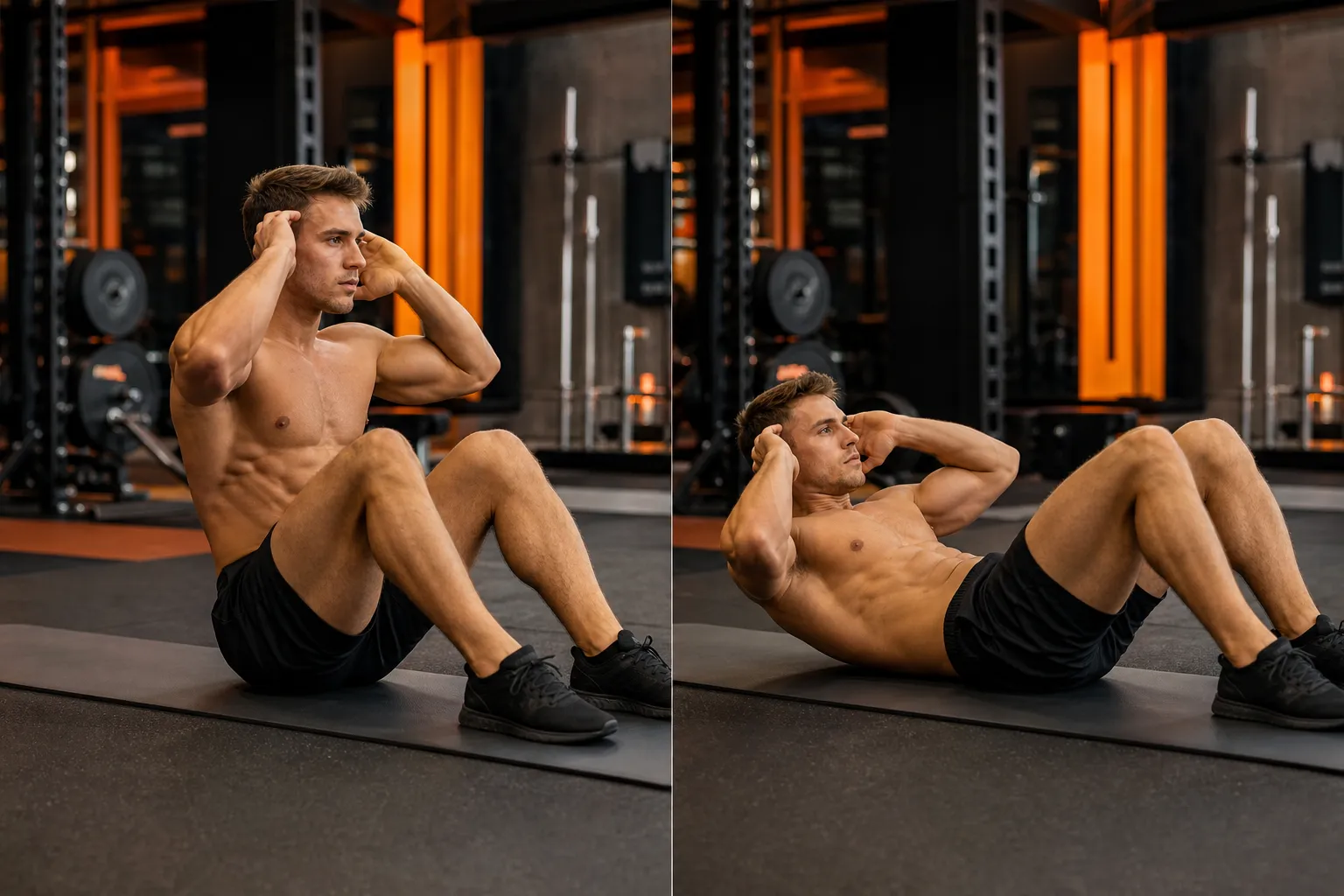
Both exercises curl the spine with the abs. The difference is where each one stops - and that difference decides which belongs in your program.
| Sit-up | Crunch | |
|---|---|---|
| Range | Full: lying to sitting | Shoulder blades off the floor |
| Primary muscles | Abs + hip flexors | Abs only |
| Lower-back load | Higher (repeated full flexion + psoas pull) | Lower (spine barely leaves the floor) |
| Best for | Athletes needing the full trunk-to-hip pattern | Isolating abs, sensitive backs, high-rep sets |
Choose sit-ups if your back is healthy, your hips are strong, and your sport demands getting the torso up against resistance - grappling, gymnastics, kickboxing. Choose crunches if the goal is simply bigger, better-isolated abs with the least spinal stress; our complete crunches guide covers that movement in full. Doing both is not a compromise - many programs use crunches for ab volume and sit-ups at low volume for the full pattern.
Are Sit Ups Bad for Your Back?
Here is the evidence-based middle ground between "sit-ups are dead" and "they never hurt anyone".
The concern is real: every sit-up flexes the lumbar spine under compressive load, and the psoas - the main hip flexor - attaches directly to the lumbar vertebrae and pulls on them during the top half of the movement. Spine researchers such as Dr. Stuart McGill have spent decades showing that thousands of repeated loaded flexion cycles contribute to intervertebral disc wear over time. High daily sit-up volume with bouncing form is a genuinely poor idea.
The panic is overblown: moderate volumes of clean sit-ups are well tolerated by healthy spines, and exercise is one of the best-supported treatments for existing chronic low back pain - a systematic review of core stability exercise found it as effective as conventional exercise for reducing pain. The people who get hurt are almost always doing high-rep, degraded-form daily challenges, often on top of eight seated hours a day with already-shortened hip flexors.
Practical rules that keep sit-ups spine-friendly:
- Stop at back ache, not ab burn: a sharp pinch in the lower back means the discs are complaining - switch to crunches or planks.
- Keep the lower back from slamming: lower under control; the eccentric should be slow enough to feel each vertebra touch down.
- Counterbalance the flexion: if you sit all day, pair sit-ups with extension work like glute bridges so the trunk is not only ever flexing.
- Who should skip them: anyone with an active disc problem, osteoporosis, or physician-advised spinal precautions - the plank family gives you core work without the flexion.
Key Takeaways
| Point | Recommendation |
|---|---|
| Primary muscles | Rectus abdominis and obliques curl the spine; hip flexors (iliopsoas, rectus femoris) drive the top half |
| Best dose | 2-3 sets of 10-20 controlled reps, 2-3 times per week |
| Form anchors | Light hands behind ears, chin tucked, 2-3s lowering, no foot anchoring |
| Back safety | Moderate volume, clean form; swap to crunches or planks if the back - not the abs - aches |
| Fat loss | No spot reduction; visibility of abs depends on overall body fat |
- A sit-up is a crunch plus a hip-flexor exercise - program it knowing both halves are in there
- Quality over rep counts: 15 slow reps beat 100 bounced ones for strength and for your spine
- Rotate trunk work: sit-ups (flexion), planks (anti-extension), glute bridges (extension) cover the core from every angle
- If the neck or lower back is doing the complaining, the exercise has already broken down - regress, do not push through
Frequently Asked Questions
Are sit ups bad for your back?
Not inherently - the dose and your form decide. Each sit-up flexes the lumbar spine under load and recruits the psoas, a hip flexor that attaches to the lumbar vertebrae, so thousands of sloppy reps can irritate the discs and surrounding tissue. But healthy spines handle moderate volumes of clean sit-ups (2-3 sets of 10-20, a few times per week) without issue, and core exercise is actually a standard part of treating chronic low back pain in rehabilitation research. If your lower back aches during sit-ups - a sharp, pinching feeling rather than abdominal muscle burn - swap to crunches or planks and build back up gradually.
Sit ups vs crunches: which is better for abs?
For most people, crunches. A crunch stops where the rectus abdominis finishes its job - shoulder blades off the floor - so the abs do nearly all the work with the lower back supported. A sit-up continues to a full sitting position, which means the second half of the movement is driven by the hip flexors, not the abs. Choose sit-ups when you are a healthy, trained athlete who specifically needs that full trunk-to-hip pattern (combat sports, gymnastics, sprinting); choose crunches when the goal is simply stronger, better-isolated abs.
How many sit ups should I do a day?
There is no magic daily number. Quality beats volume: 2-3 sets of 10-20 slow, controlled repetitions two or three times per week is plenty of stimulus for a bodyweight movement, especially once you can pause at the top and lower for a slow 3-second count. If you can exceed 20 clean reps, the exercise has become endurance work - progress by adding resistance, slowing the tempo, or moving to harder variations rather than chasing rep counts.
Do sit ups burn belly fat?
No - and this is one of the most persistent myths in fitness. Spot reduction does not work: a 2011 study in the Journal of Strength and Conditioning Research had participants do abdominal exercise five days a week for six weeks, and it did not reduce belly fat compared to the control group. Sit-ups strengthen the abdominal muscles underneath, but those muscles only become visible when overall body fat drops, which requires a calorie deficit from diet plus full-body training. Train your core for strength and use our TDEE calculator to handle the fat-loss side of the equation.
What happens if I do 100 sit ups a day?
The first week you will be sore. After that, three things happen in sequence: your nervous system adapts and the soreness fades, the exercise becomes pure endurance work with diminishing returns for strength or muscle, and - if your form breaks down at high fatigue - your neck and lower back start doing work they should not. Doing 100 sit-ups a day is not dangerous for a healthy, trained person, but 3 sets of 15 controlled reps will build more muscle than 100 rushed ones. If you want a daily core habit, rotate sit-ups with planks and glute bridges so the same tissue is not loaded the same way every day.
References & Sources
BMI Calculator
Calculate your body mass index (BMI) and see your WHO weight category instantly. BMI is a quick screening tool that compares your weight to your height - this calculator also shows the healthy weight range for your height so you know your target.
TDEE Calculator (Daily Calories)
Calculate your Total Daily Energy Expenditure (TDEE) - the number of calories you burn each day. The calculator uses the Mifflin-St Jeor equation for your basal metabolic rate, multiplied by your activity level.