
How to Do Leg Raises: Form Guide, Muscles Worked & the Lying vs Hanging Truth
Leg raises are a floor core exercise that trains the lower abs and hip flexors through hip flexion. Lie on your back with hands beside your hips, keep your legs nearly straight, raise them to vertical, then lower slowly - stopping just before your lower back arches off the floor. If your back lifts or aches, bend your knees or shorten the range.
Why Leg Raises Deserve a Spot in Your Core Training

Crunches, sit-ups, and most gym-class abs work train the core from the top down: the ribcage curls toward the pelvis. Leg raises attack from the other end - the legs move at the hips while the abs fight to hold the pelvis and spine still. That reversed job is exactly what many programs are missing.
Three things make leg raises worth programming:
- Lower-ab emphasis without repeated spinal flexion: unlike sit-ups, which flex the lumbar spine rep after rep, the lying leg raise keeps the spine close to neutral while the lower fibers of the rectus abdominis control the pelvis - a genuinely different stress for the same muscle sheet.
- Pelvic control that carries over: the skill of stopping your pelvis from tipping forward under load is the same skill that protects your spine in squats, deadlifts and sprints.
- Zero equipment and a built-in difficulty dial: the floor version needs only a mat, and the same pattern scales all the way to hanging from a bar - one of the few core movements with a years-long progression.
The honest caveat: done sloppily, leg raises quietly turn into a lower-back exercise - the hips lift, the lumbar spine arches, and the psoas pulls on the very vertebrae you were trying to protect. The form section below is where that gets fixed.
How to Do Lying Leg Raises with Perfect Form
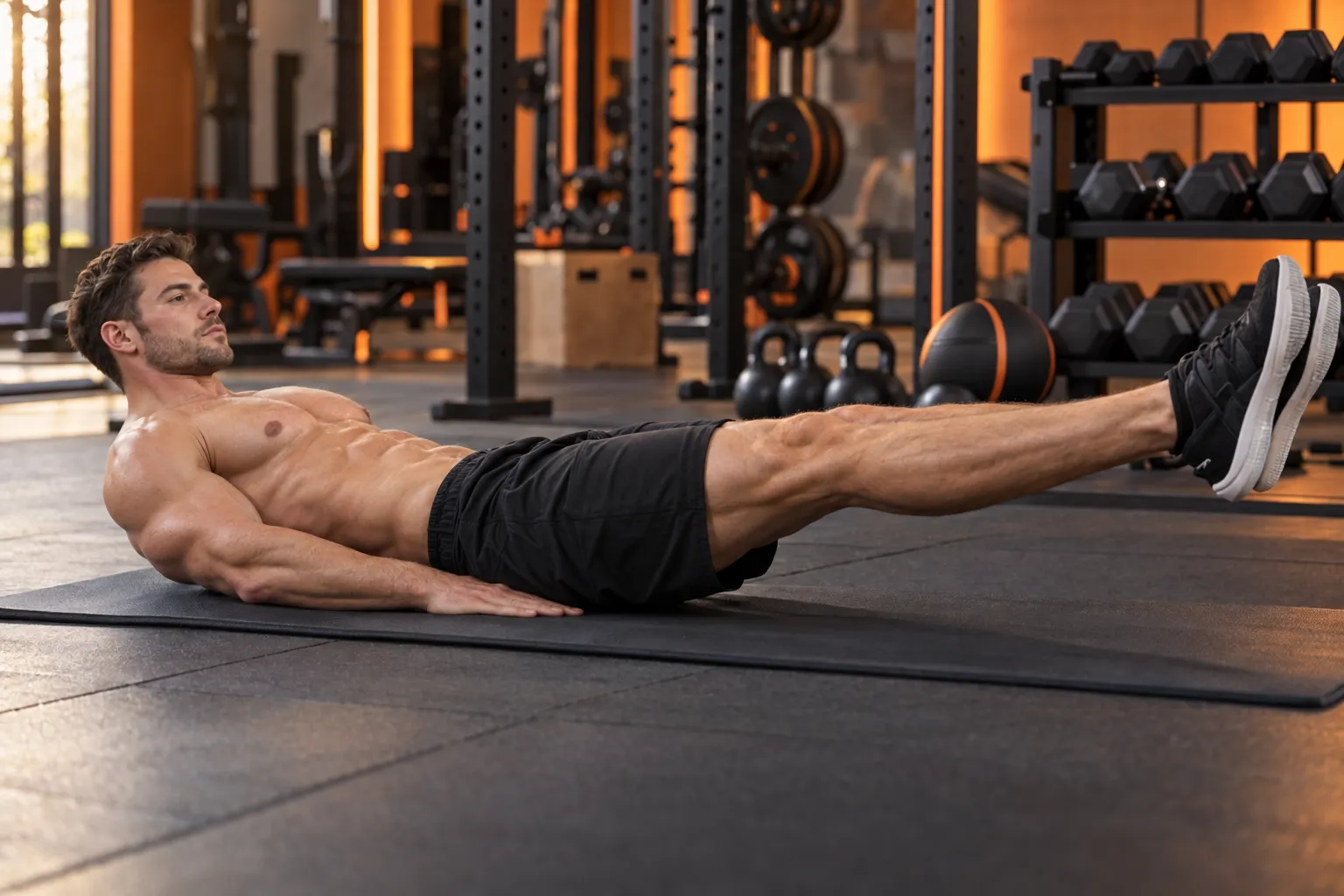
The lying leg raise looks like one simple hinge, but the exercise lives or dies on the last few inches before the floor. Here is the sequence, floor to finish.
Step 1 - Setup: Lie on your back with legs together and nearly straight, heels a few inches off the floor to start. Place your hands palms-down under the sides of your hips or flat on the floor beside you - never behind your head, because a bracing yank on the neck is the most common beginner error. Keep your head and shoulders heavy on the mat.
Step 2 - The raise: Exhale and brace your abs as if bracing for a light punch, then lift your legs smoothly toward vertical, moving only at the hips. The toes stay relaxed, the knees stay almost straight, and the pelvis stays glued to the floor. Reaching vertical is not required - raise only as high as you can without the pelvis rolling up behind you.
Step 3 - The lowering: This is the actual exercise. Lower your legs on a slow 3-4 second count, and stop the moment your lower back begins to arch off the floor - for most people that is somewhere between 15 and 45 degrees above the floor. That point is the true end of your range today; the abs are no longer holding the pelvis, and everything past it is lumbar spine doing someone else's job.
Step 4 - Breathing and tempo: Exhale as the legs rise, inhale as they fall, roughly 2-3 seconds up and 3-4 seconds down. In my experience coaching beginners, two tells expose a broken leg raise every time: toes that race to the floor (tempo too fast to control the pelvis) and a back that arches while the legs are still high. Both have the same fix - bend the knees to shorten the lever and rebuild the range slowly, the same way you would regress crunches when the neck takes over.
A note on volume: 2-3 sets of 8-15 controlled reps beats a daily hundred, and the first quality to earn is not height but a silent, still pelvis.
What Muscles Do Leg Raises Work? (The Lower-Ab Truth)

A leg raise is a hip-flexion movement wearing an ab costume. Knowing who does what changes how you use it:
Muscles Worked
- Hip flexors (the engine): the iliopsoas and rectus femoris lift the legs at the hip. These are strong muscles doing the visible work - if you feel leg raises mostly in the front of your hips, that is anatomy, not bad form.
- Rectus abdominis, lower fibers (the brakes): the abs do not lift the legs - they prevent the pelvis from tipping forward as the legs lower. The eccentric fight to keep the lumbar spine flat is the part that feels like "lower ab" work.
- Obliques and deep stabilizers: the obliques and transverse abdominis keep the pelvis and ribcage level from side to side, which is why the legs want to wobble as fatigue builds.
The Lower-Ab Truth
The rectus abdominis is one sheet of muscle with one leash of connective tissue - you cannot contract only its lower half, and "lower abs" as a separate muscle does not exist. What you can do is bias the lower fibers: leg raises load the abs exactly where those fibers attach, at the pelvis. That is why they complement crunches (which load the abs from the ribcage end) instead of duplicating them. As for visibility - whether any of this shows - that is a body-fat question with an unpopular answer, covered honestly in the FAQ below.
Lying vs Hanging Leg Raises: Which Is Better?
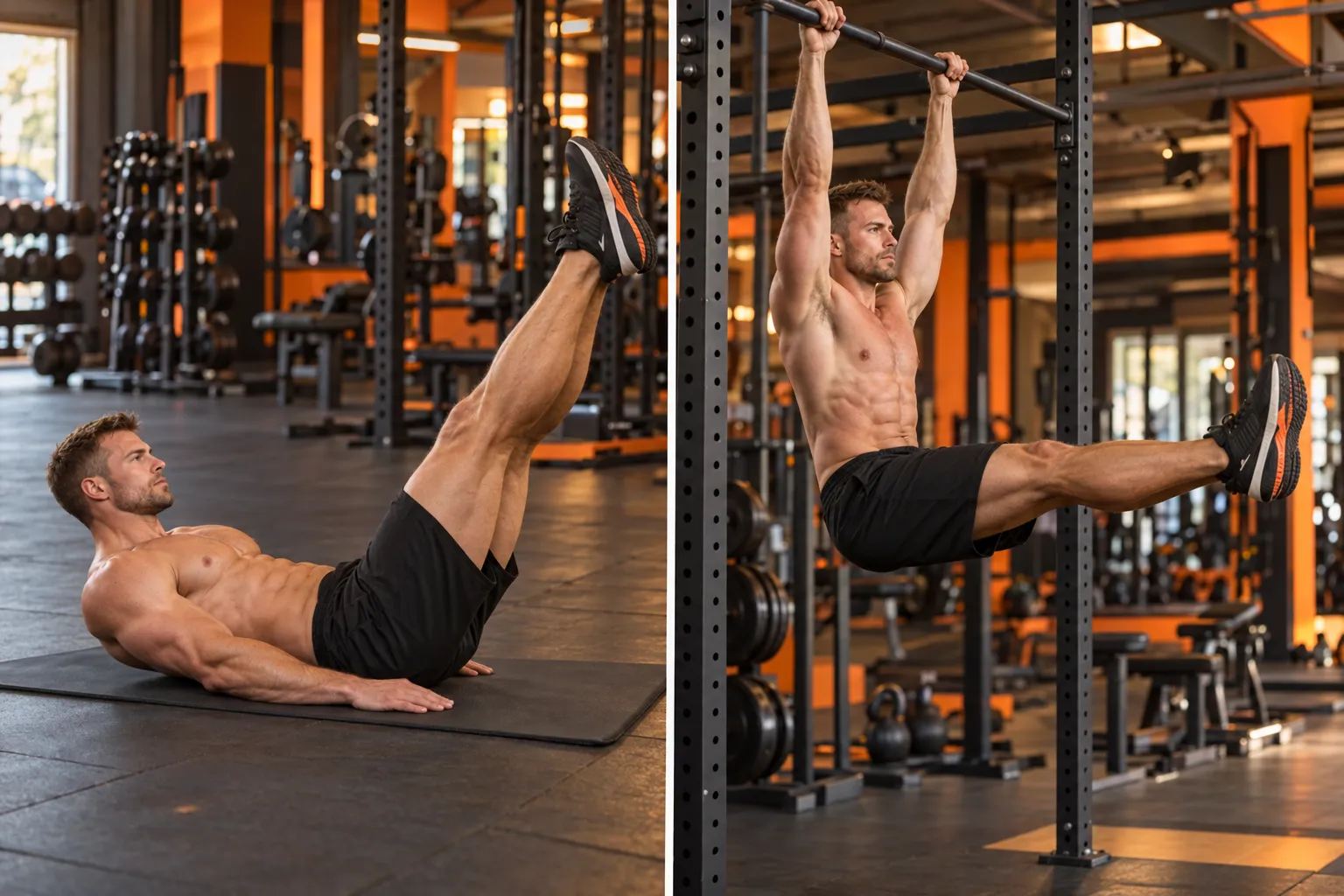
Same pattern, two difficulty worlds. The lying version lets the floor hold your pelvis honest; the hanging version removes the floor and makes your whole body earn the rep.
| Lying leg raise | Hanging leg raise | |
|---|---|---|
| Setup | Floor mat, zero equipment | A pull-up bar |
| Difficulty | Beginner-friendly, instantly regressible (bend the knees) | Advanced - grip and shoulder stability fail before the abs do |
| Ab demand | Moderate (pelvis supported by the floor) | High (abs control the pelvis from a hanging position) |
| Hip-flexor demand | Moderate | High |
| Back friendliness | Easy to monitor - you feel the arch instantly | Harder to monitor; requires earned shoulder and core control |
| Best for | Building pelvic control, sensitive backs, home training | Trained athletes chasing progressive core strength |
Which is "better" depends on where you are. The classic San Diego State EMG study commissioned by the American Council on Exercise ranked the captain's chair - essentially hanging knee raises - among the top exercises for both the rectus abdominis and the obliques, so the ceiling is clearly higher when you hang. But the hanging version has no honest regression once form breaks, while the lying version tells you the moment your pelvis quits. The efficient path is not choosing a camp: build 15 controlled lying reps with a still pelvis, then progress through bent-knee hanging raises to straight legs. The bent-knee lying raise, for the record, is also the right starting point if your back is sensitive - the shorter lever cuts the torque on the lumbar spine dramatically while training the identical skill. Pair the whole progression with planks (anti-extension) and you have both directions of core strength covered in one short session.
Are Leg Raises Bad for Your Lower Back?
Here is the evidence-based middle ground between "leg raises are a spine wrecker" and "they never bothered anyone".
The concern is real: the psoas - the strongest hip flexor - attaches directly to the lumbar vertebrae. Every rep where the pelvis tips forward and the lower back arches off the floor puts those vertebrae under loaded extension while the psoas pulls on them, and spine researchers have spent decades documenting what thousands of such cycles cost intervertebral discs. People with desk-shortened hip flexors and weak deep abs are doing exactly this without realizing it, because the arch is subtle and the rep still "feels" finished.
The panic is overblown: controlled-range leg raises are a standard rehabilitation tool, not a threat - exercise in general, and structured core stability work in particular, is one of the best-supported treatments for chronic low back pain in systematic reviews. The people who get hurt are almost never doing 8-15 controlled reps; they are racing daily rep challenges with an arched back and no range awareness.
Practical rules that keep leg raises spine-friendly:
- Find your end range and respect it: the moment the lower back arches, the rep is over - today. Range grows with strength, not willpower.
- Hands under the hips: a small pelvic tilt backward before the first rep pre-positions the lumbar spine flat and gives you instant feedback through your hands.
- Brace before the legs move: exhale and set the abs first, then lift. Legs leading a soft trunk is the arch in the making.
- Counterbalance the flexion-bias: if you sit all day, pair leg raises with mountain climbers for conditioning or glute bridges for extension so the hips are not only ever working in one direction.
- Who should regress first: anyone with an active disc problem, spondylolisthesis, or physician-advised spinal precautions should start with the bent-knee version and a shortened range, and treat planks as the default core tool until cleared.
Key Takeaways
| Point | Recommendation |
|---|---|
| Primary muscles | Hip flexors lift the legs; lower fibers of the rectus abdominis control the pelvis; obliques stabilize |
| Best dose | 2-3 sets of 8-15 slow reps, 2-3 sessions per week |
| Form anchors | Hands under hips, brace before the lift, 3-4s lowering, stop before the back arches |
| Progression | Bent-knee lying → straight-leg lying → bent-knee hanging → straight-leg hanging |
| Fat loss | No spot reduction; visible abs depend on overall body fat, not rep counts |
- A leg raise is a hip-flexion move with the abs as the brakes - train both roles knowingly
- Your range ends where the arch begins; bending the knees is a legitimate progression reset, not a failure
- Rotate trunk work: leg raises (anti-tilt), crunches and sit-ups (flexion), planks (anti-extension) cover the core from every angle
- Shaking legs are fatigue; sharp back or hip pinches are stop signals - learn the difference early
Frequently Asked Questions
Are leg raises bad for your back?
Not when the range matches your control. The problem is not the raise itself but the lowering: your psoas - the main hip flexor - attaches to your lumbar vertebrae, and when you lower your legs past the point where your abs can hold the pelvis level, the pelvis tips forward and the lower back arches off the floor under load. Thousands of sloppy, arched reps like that can irritate the discs over time. Keep your hands under your hips, stop each rep just before the arch appears, bend your knees to shorten the lever, and moderate volume (2-3 sets of 8-15 clean reps) is well tolerated by healthy spines - core training is in fact a standard part of treating chronic low back pain in rehabilitation research.
Lying vs hanging leg raises: which is better?
They are the same movement at two very different difficulty levels, and the hanging version is the stronger tool if you can control it. Lying leg raises let the floor support your pelvis, making them easier to keep honest - the moment your lower back arches you can feel it, and you can instantly bend your knees to regress. Hanging leg raises remove that support, force your grip, shoulders and lats to stabilize the whole chain, and load the hip flexors and abs harder; the classic San Diego State EMG study commissioned by the American Council on Exercise ranked the captain's chair - essentially hanging knee raises - among the very top exercises for both the rectus abdominis and the obliques. If you cannot yet hang and control a full rep, build the lying version first and progress through bent-knee hanging raises to straight legs.
How many leg raises should I do a day?
You do not need a daily number, and daily is not the goal - recovery is. Two or three sessions per week of 2-3 sets of 8-15 slow reps is plenty of stimulus: the lowering phase should take a 3-second count, because that eccentric control is where the lower abs actually work. If you can exceed 15 clean reps with straight legs and no back arch, do not add endless reps - progress the movement instead by moving to hanging raises, slowing the tempo further, or holding a light dumbbell between your feet.
Do leg raises burn lower belly fat?
No - there is no such thing as spot reduction, and the lower belly is not an exception. A 2011 study in the Journal of Strength and Conditioning Research had participants train their abdominals five days a week for six weeks; belly fat did not budge compared to the control group. Leg raises strengthen the muscles underneath, but those muscles only become visible when overall body fat drops, which comes from a calorie deficit and full-body training. Use our TDEE calculator to set that deficit, and treat leg raises as strength work for the core, not as a fat-burning tool.
Why do my legs shake during leg raises?
Usually it is fatigue of the deep stabilizers - the hip flexors and the lower fibers of the abs working near their limit to control the pelvis - and it is harmless in itself. Quads cramping is a close second, especially if your knees are locked and you are dehydrated or short on sleep. Treat the shake as a signal that form is about to break: end the set, or shorten the range so the pelvis stays quiet. As those muscles get stronger over a few weeks the shaking shows up later and later. If you feel a sharp pinch in the hip or groin rather than muscle shake, stop, switch to the bent-knee version, and build the range back gradually.
References & Sources
BMI Calculator
Calculate your body mass index (BMI) and see your WHO weight category instantly. BMI is a quick screening tool that compares your weight to your height - this calculator also shows the healthy weight range for your height so you know your target.
TDEE Calculator (Daily Calories)
Calculate your Total Daily Energy Expenditure (TDEE) - the number of calories you burn each day. The calculator uses the Mifflin-St Jeor equation for your basal metabolic rate, multiplied by your activity level.